In this post I will follow the beggining of Chapter 3 of Chris Heunen and Jamie Vicary's Categories for Quantum Theory. I will focus on the concept of dual objects and dualizability, which in the context of categorical quantum mechanics captures the notion of maximally entangle states (Bell states, etc). In the graphical calculus, this enables wires to bend backwards in time.
Dual objects
Definition (Left and Right Dual object)
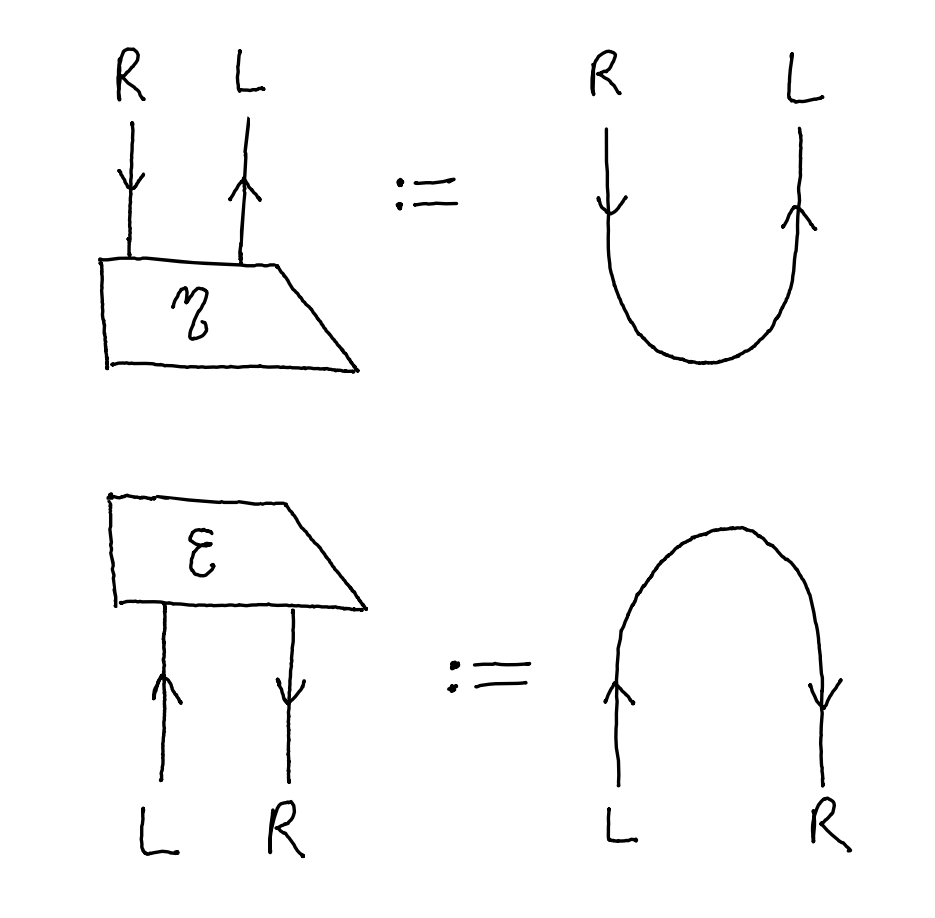
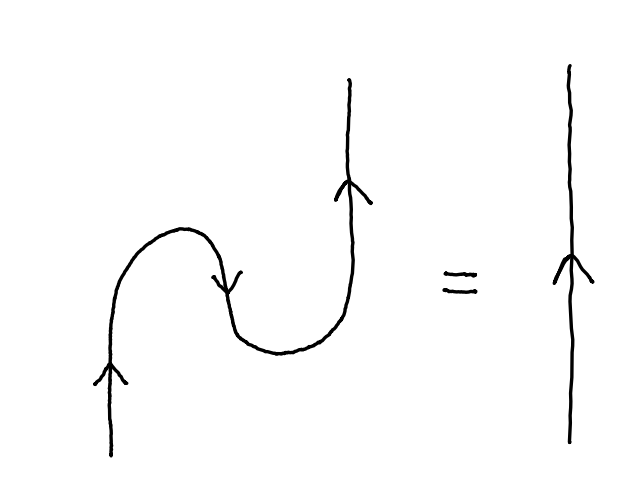
In a monoidal category \(\boldsymbol{C}\), \(L\in\text{Ob}(\boldsymbol{C})\) is called the left-dual to \(R\in\text{Ob}(\boldsymbol{C})\) and \(R\) is the right-dual to \(L\), written as \(L\dashv R\), when there exists a unit morphism \(\eta:I\to R\otimes L\) and a counit morphism \(\varepsilon:L\otimes R\to I\) such that the following diagram commutes
Definition (Dual object)
Let \(\boldsymbol{C}\) be a monoidal category, and let \(L,R\in\text{Ob}(\boldsymbol{C})\). \(L\) is a dual of \(R\) if \(L\dashv R\) and \(R\dashv L\).
In the graphical calculus, dual objects can be included by including an orientation, i.e. an arrow, in each wire. An object \(L\) is drawn as a wire with an upward pointing arrow, and a right-dual \(R\) as a wire with a downward pointing arrow.
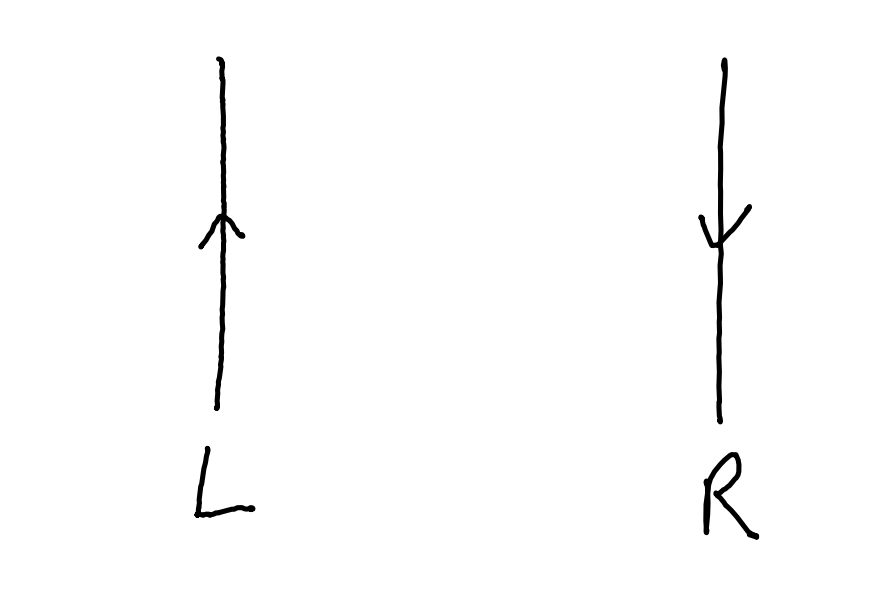
Similarly, the unit \(\eta:I\to R\otimes L\) and counit \(\varepsilon:L\otimes R\to I\) are generally not represented by morphism boxes. Instead, they are drawn as bent wires, called the cup and the cap:
The duality comutative diagrams are then rendered as the famous snake or zigzag equations
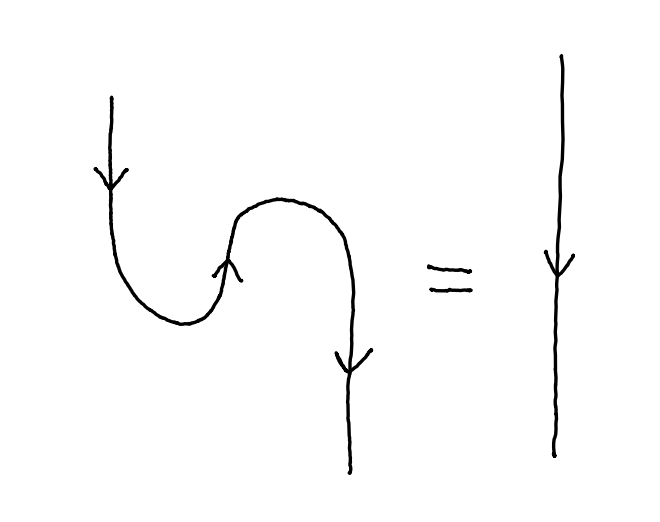
Definition (Dualizability)
Let \(\boldsymbol{C}\) be a monoidal category. An object \(A\in\text{Ob}(\boldsymbol{C})\) is said to be dualizable if it admits both left and right duals.
Definition (Rigid monoidal category)
A monoidal category \(\boldsymbol{C}\) is rigid if every object \(A\in\text{Ob}(\boldsymbol{C})\) is dualizable.
Definition (Name and Coname)
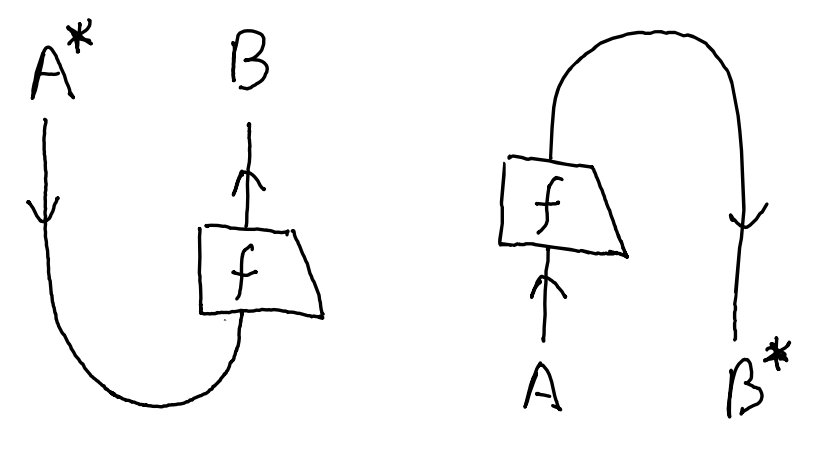
In a monoidal category \(\boldsymbol{C}\) with dualities \(A\dashv A^{*}\) and \(B\dashv B^{*}\), given a morphism \(f:A\to B\), its name is \(\left\lceil f\right\rceil :I\to A^{*}\otimes B\) and its coname is \(\left\lfloor f\right\rfloor :A\otimes B^{*}\to I\). Graphically we have
Theorem (Choi-Jamiolkawsky correspondence)
A morphism can be recovered from its name using the snake equations.
Proof
Simply note that the equality
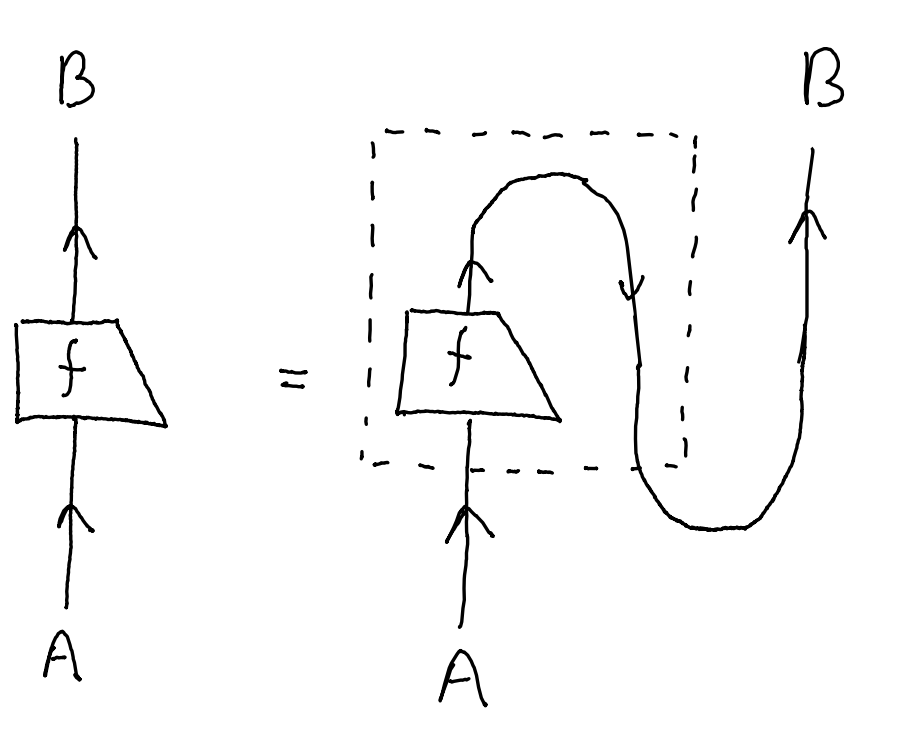
defines an isomorphism between names and the corresponding morphisms.
Lemma (Uniqueness)
Let \(\boldsymbol{C}\) be a monoidal category with \(L,R\in\text{Ob}(\boldsymbol{C})\) and \(L\dashv R\), then \(L\dashv R'\) if and only if \(R\simeq R'\). Similarly, if \(L\dashv R\) then \(L'\dashv R\) if and only if \(L\simeq L'\).
Proof
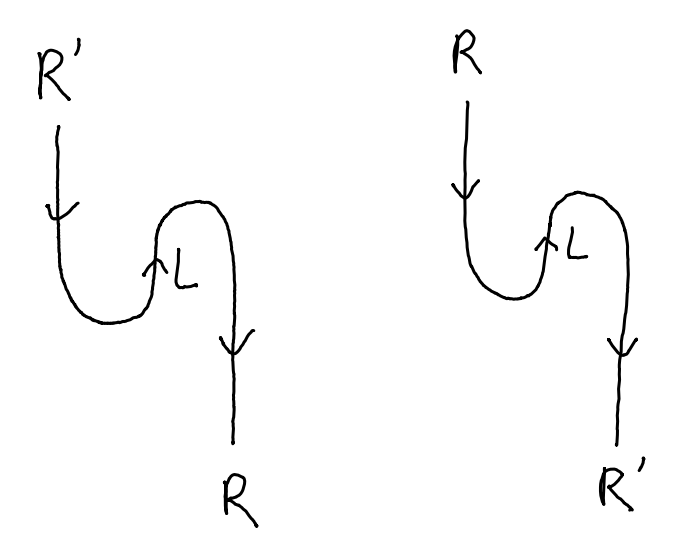
Let us assume that \(L\dashv R\) and \(L\dashv R'\), then we can define maps \(R'\to R\) and \(R'\to R\), where we make use of the two dualities to diagramatically write
By concatenating both of these maps, we have
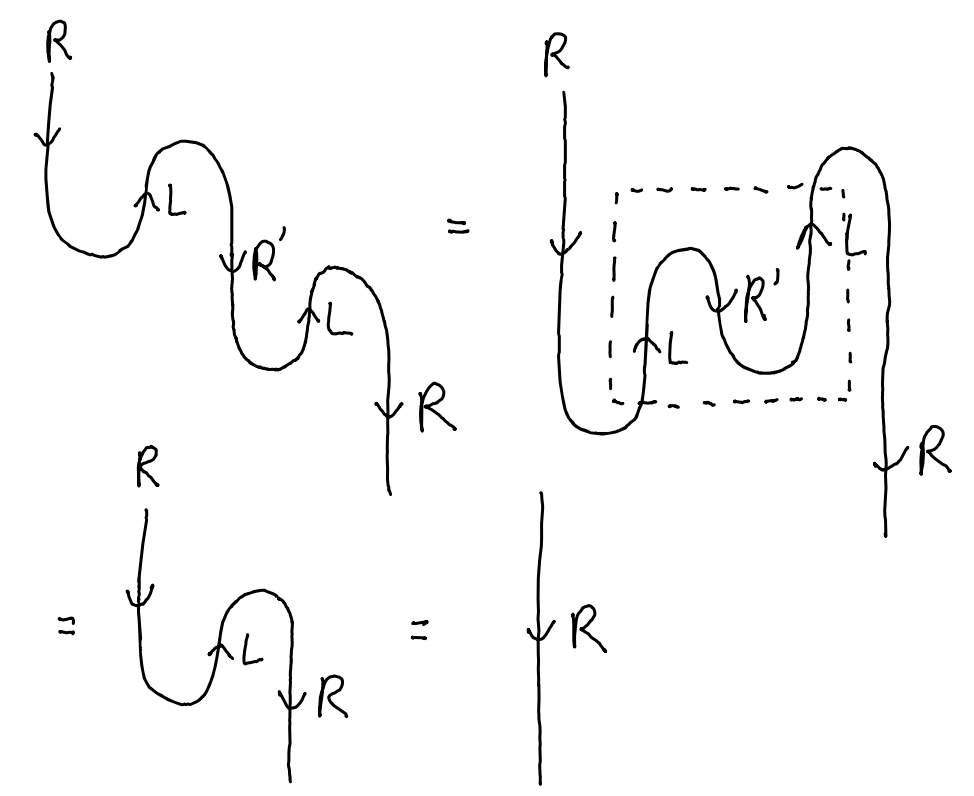
which means they are inverses. This is enough to prove that both maps are isomorphisms \(R\simeq R'\). The proof for the other zig-zag equation follows this exact one.
Conversely, let \(f:R\to R'\) be an isomorphism and \(L\dashv R\) be a duality with cup \(\eta\) and cap \(\varepsilon\), then we can construct a cap \(\varepsilon\circ\left(\text{id}_{L}\otimes f^{-1}\right)\) and a cup \(\left(f\otimes\text{id}_{L}\right)\circ\eta\), which diagramatically reads
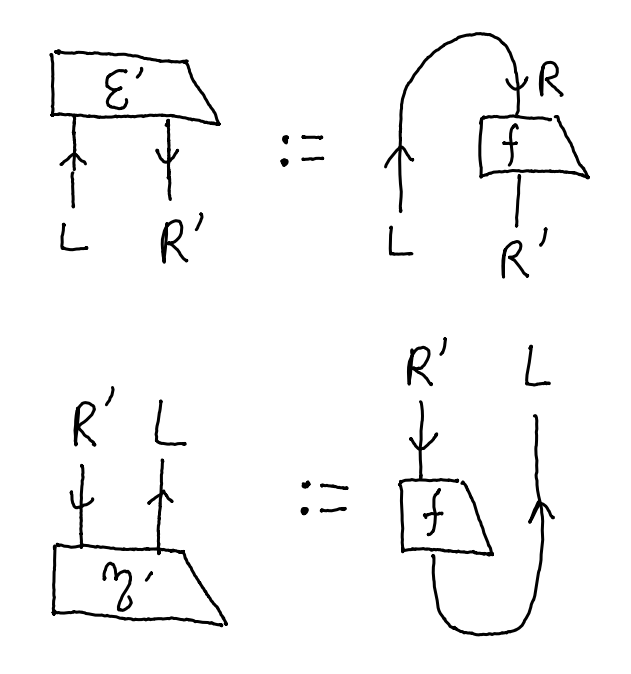
and forms a duality \(L\dashv R'\).
An isomorphism \(f:L\to L'\) would allow for an analogous construction.
Lemma (Cup determines cap)
Let \(\boldsymbol{C}\) be a monoidal category and let \(\left(L,R,\eta,\varepsilon\right)\) and \(\left(L,R,\eta,\varepsilon'\right)\) both form a duality, then \(\varepsilon=\varepsilon'\). Similarly, let \(\left(L,R,\eta,\varepsilon\right)\) and \(\left(L,R,\eta',\varepsilon\right)\) both form a duality, then \(\eta=\eta'\).
Proof
Firstly, let the notation of bent wires hold for \(\varepsilon'\). Diagramatically, one finds
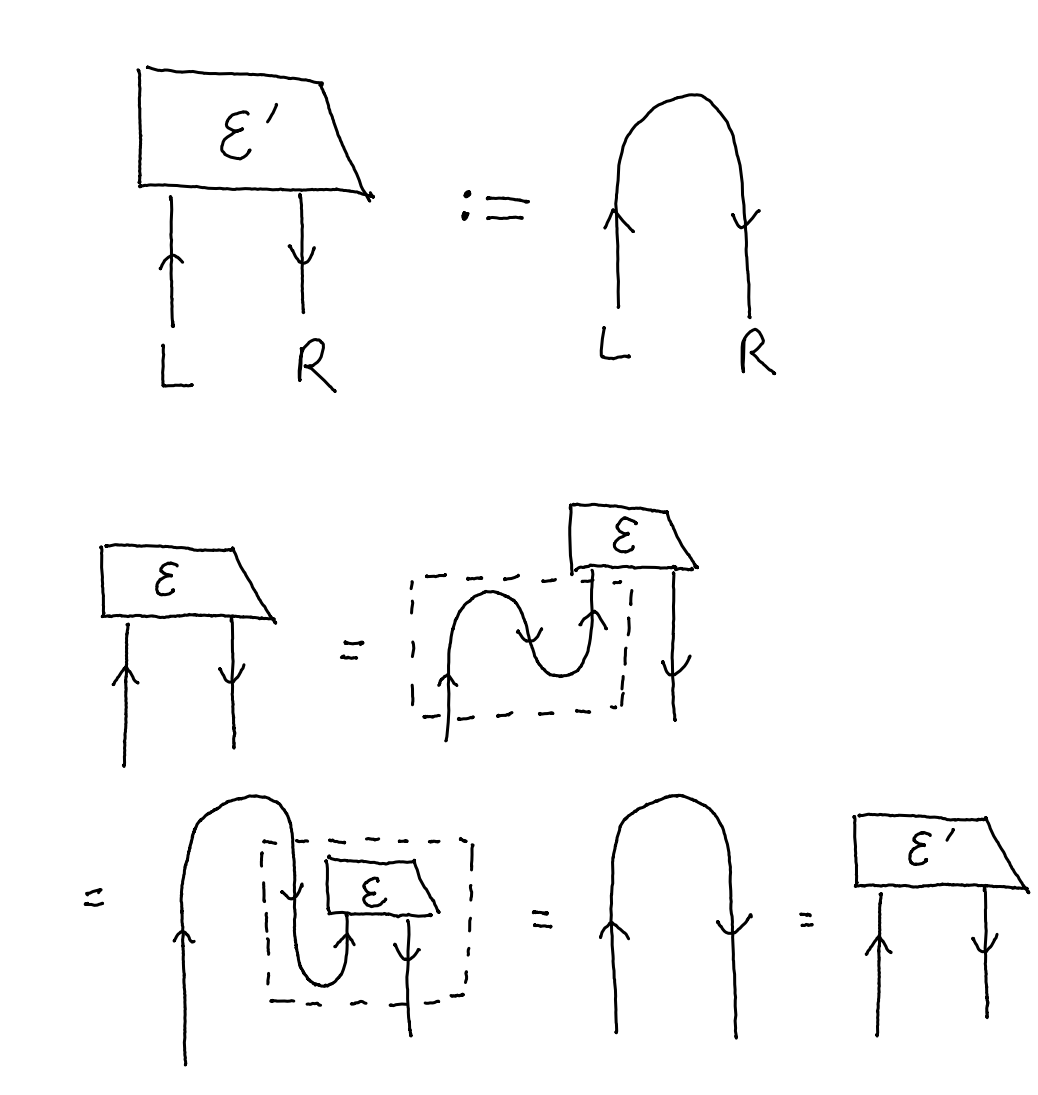
The argument can easily be reversed to prove the \(\eta=\eta'\) case.
Lemma (Self-duality of the monoidal unit)
In a monoidal category \(I\dashv I\)
Proof
Let \(\eta=\lambda_{I}^{-1}:I\to I\otimes I\) and let \(\varepsilon=\lambda_{I}:I\otimes I\to I\). This is a duality, since the snake equations follow directly from the propertie s of \(\lambda_{I}\) (coherence). Using the graphical calculus, all images are empty and the result follows trivially.
Lemma (Monoidal products of duals)
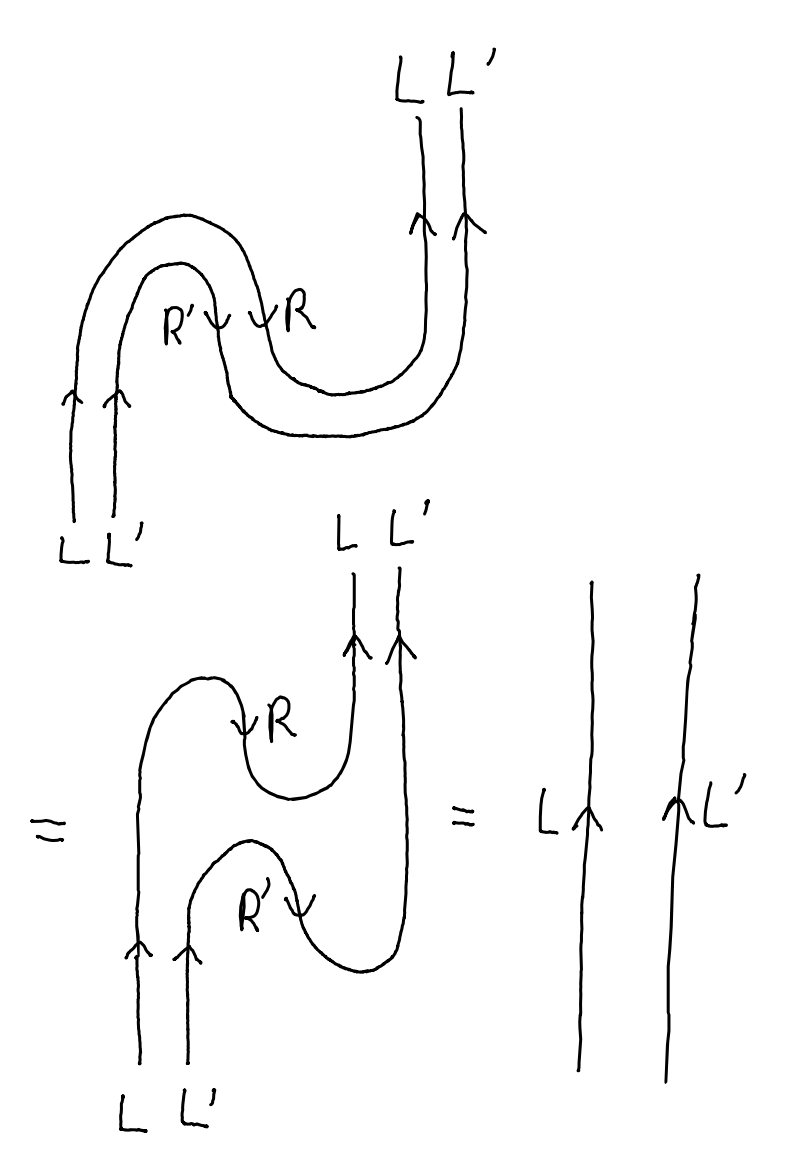
In a monoidal category \(\boldsymbol{C}\), let \(L,R,L',R'\in\text{Ob}(\boldsymbol{C})\), then \(L\dashv R\) and \(L'\dashv R'\) implies that \(L\otimes L'\dashv R\otimes R'\).
Proof
Graphically, one has
Lemma (Duality in braided monoidal categories)
In a braided monoidal category \(L\dashv R\Rightarrow R\dashv L\).
Proof
Suppose \(\left(L,R,\eta,\varepsilon\right)\) forms a duality \(L\dashv R\), then using the braiding, one can construct the duality \(\left(R,L,\eta',\varepsilon'\right)\) as
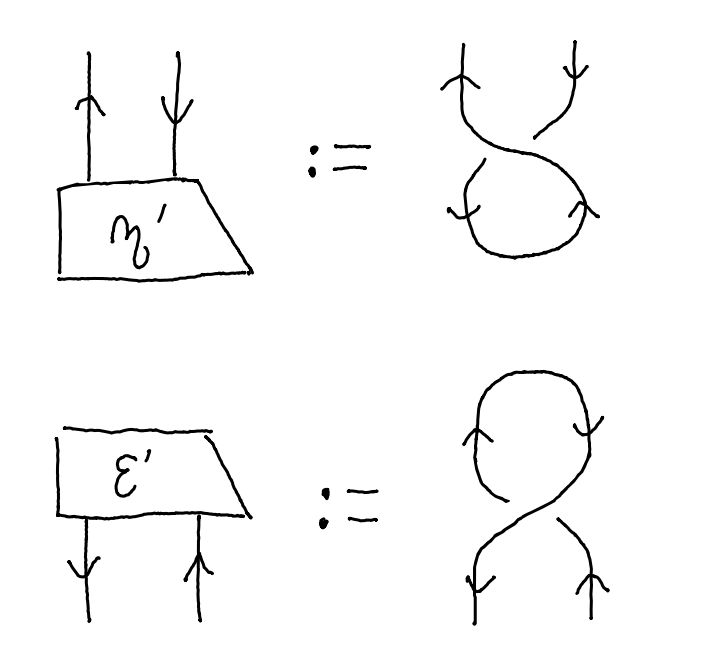
Writing the snake equations for \(\eta'\) and \(\varepsilon'\) shows that the required properties are satisfied
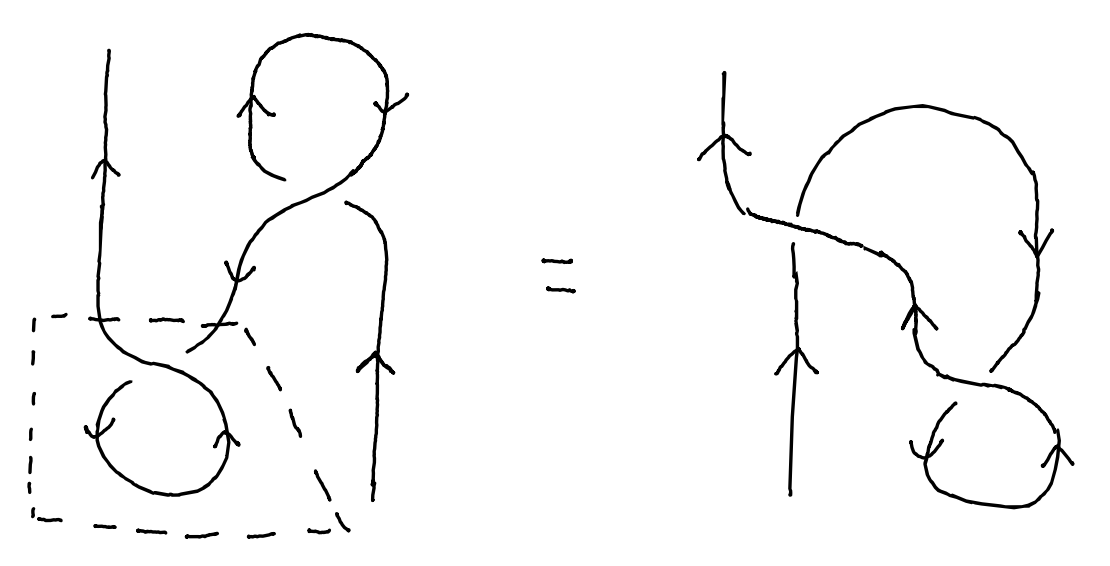
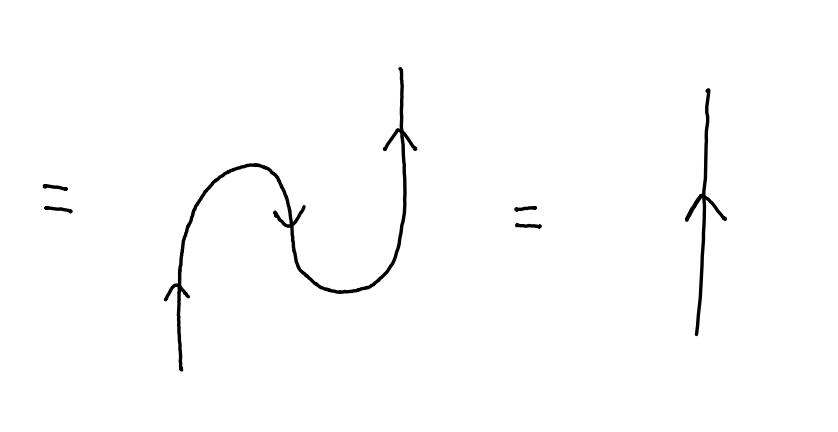
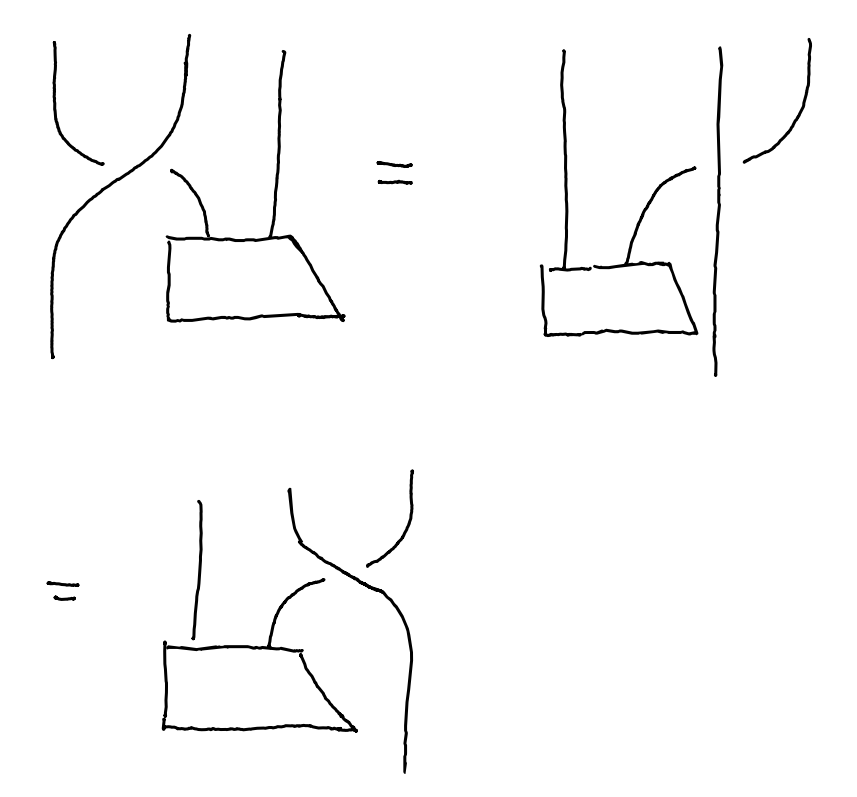
Here, we have made use of the generic manipulation
Definition (Transpose)
In a monoidal category \(\boldsymbol{C}\) for a morphism \(f:A\to B\) and dualities \(A\dashv A^{*}\) and \(B\dashv B^{*}\), the right dual, or transpose \(f^{*}:B^{*}\to A^{*}\) is defined as
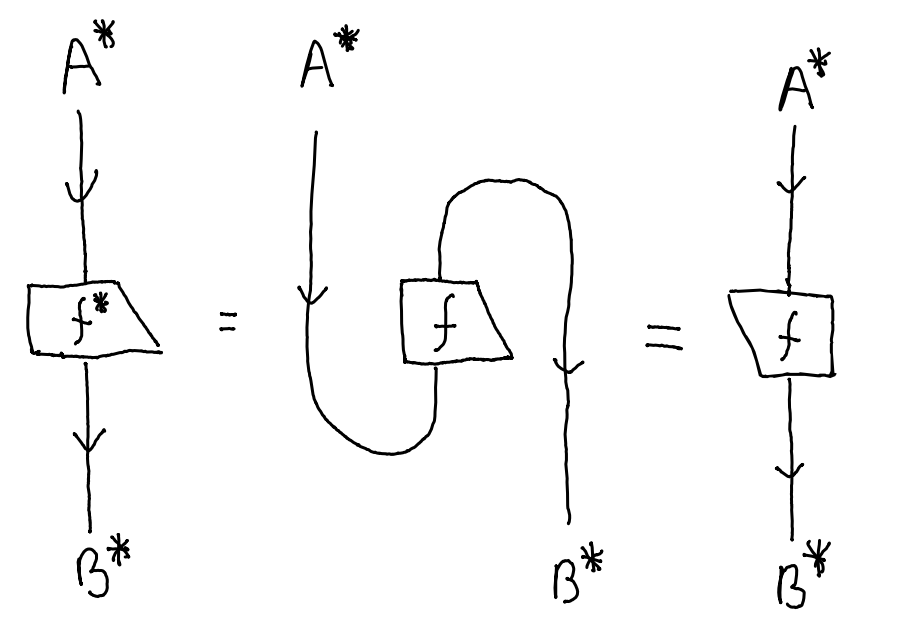
Note that he right dual is drawn by rotating the box representing \(f\).
Definition (Right dual functor)
In a monoidal category \(\boldsymbol{C}\), in which every object has a chosen right dual \(X^{*}\), the right dual functor \(\left(\cdot\right)^{*}:\boldsymbol{C}\to\boldsymbol{C}^{\text{op}}\) is defined on objects as \(\left(X\right)^{*}:=X^{*}\) and on morphisms as \(\left(f\right)^{*}=f^{*}\).
Proposition (Right dual functor is a functor)
The right dual functor satisfies the functor axioms.
Proof
Let \(f:A\to B\) and \(g:B\to C\), then
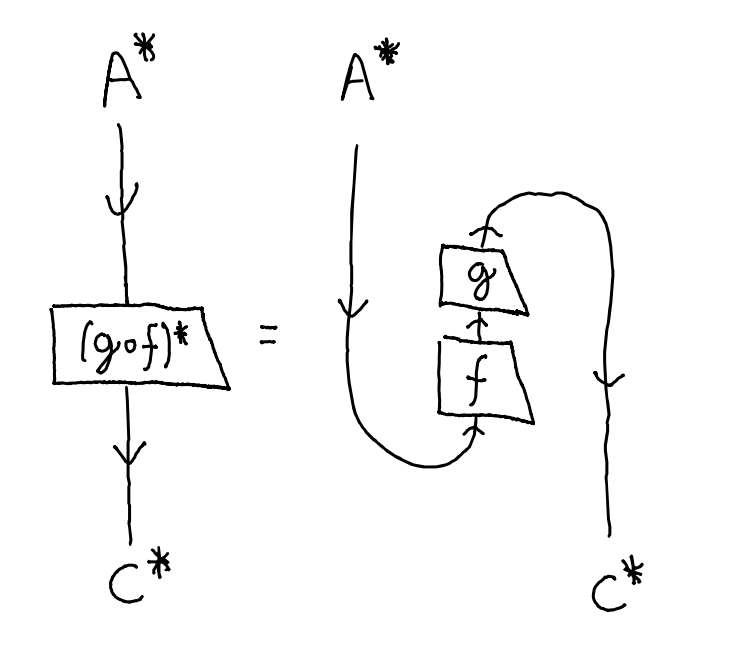
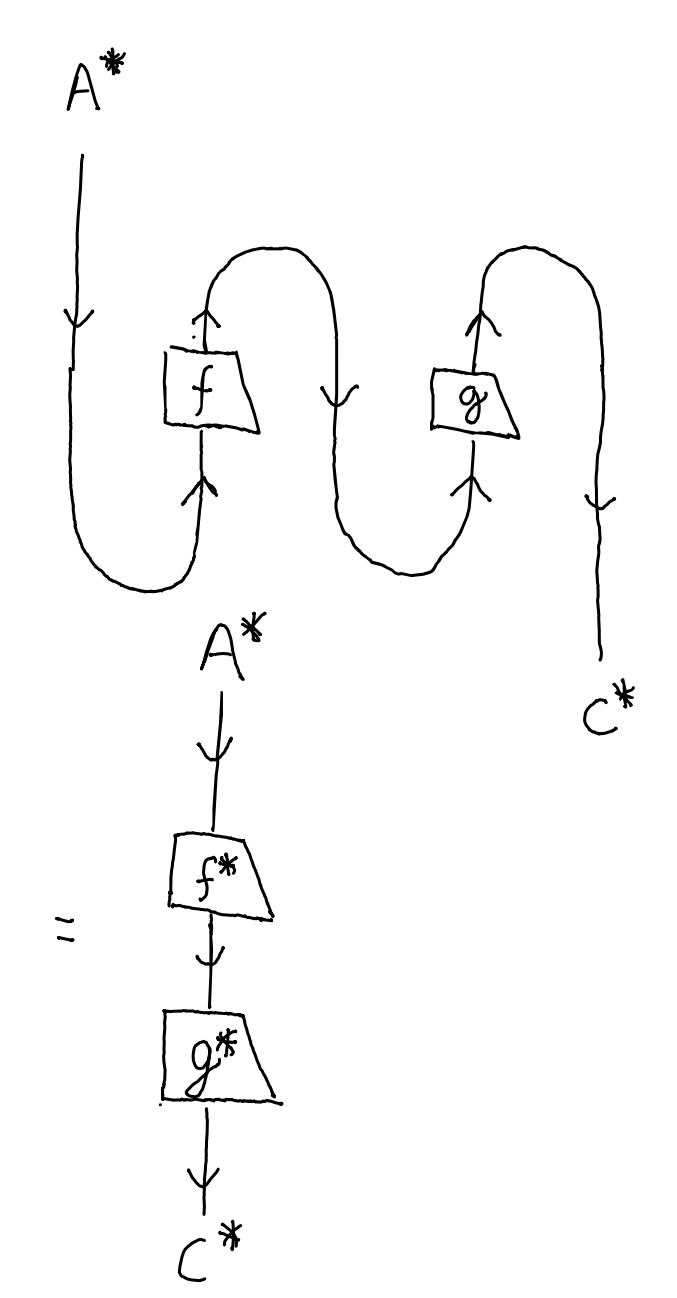
Similarly, \(\left(\text{id}_{A}\right)^{*}=\text{id}_{A^{*}}\) follows from the snake equations.
Lemma (Sliding)
In a monoidal category with chosen dualities \(A\dashv A^{*}\) and \(B\dashv B^{*}\), the following equations hold for all morphisms \(f:A\to B\)
Proof
Diagramatically, we have
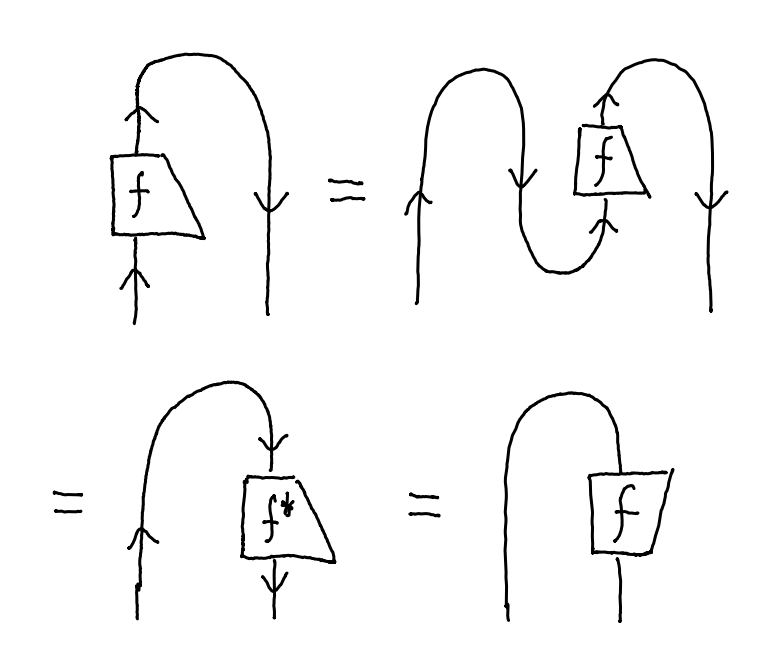
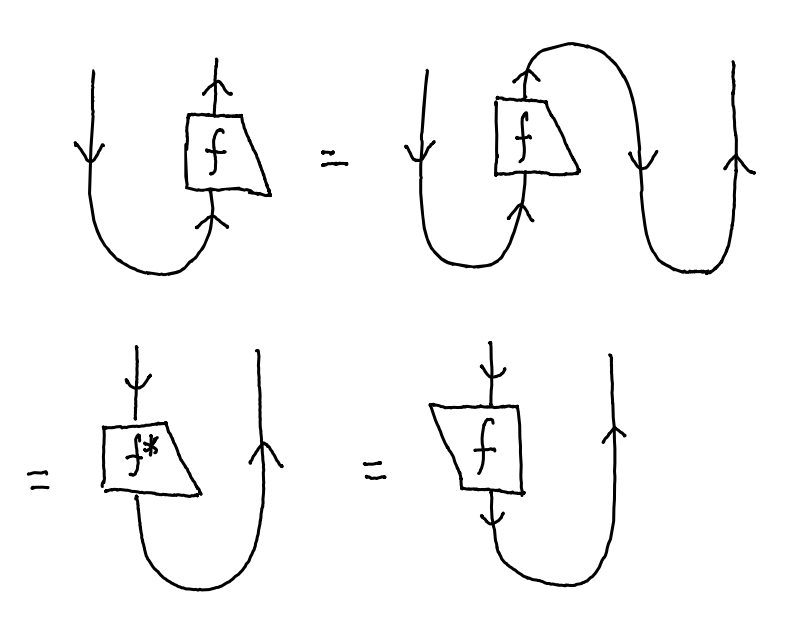
We now provide some addtional theorems without proof, regarding the interaction of monoidal structure and the dual construction.
Interaction with monoidal structure
Theorem
Monoidal functors preserve duals.
Proof
Let \(\boldsymbol{C}\) and \(\boldsymbol{C}\)' be categories and \(F:\boldsymbol{C}\to\boldsymbol{C}'\) a monoidal functor. with \(\eta:I\to A\otimes A^{*}\) and \(\varepsilon:A\otimes A^{*}\to I\) witnessing the duality \(A\dashv A^{*}\) in \(\boldsymbol{C}\). We wish to show that \(F(A)\dashv F(A^{*})\) is a duality in \(\boldsymbol{C}'\). The proof proceeds by stacking a series of commutative diagrams corresponding to monoidal functor axioms or naturality to produce one big one which amounts to the snake equations.
The first we consider is the monoidal functor axiom
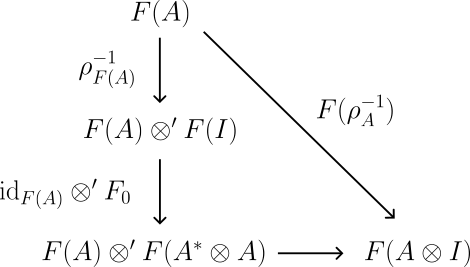
The second is naturality
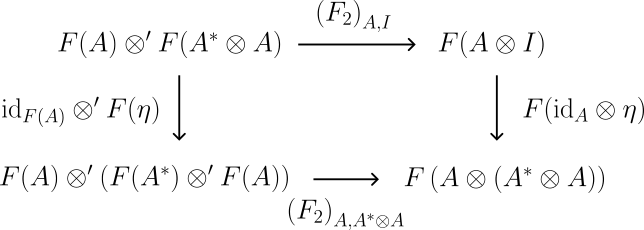
The third is the other monoidal functor axiom
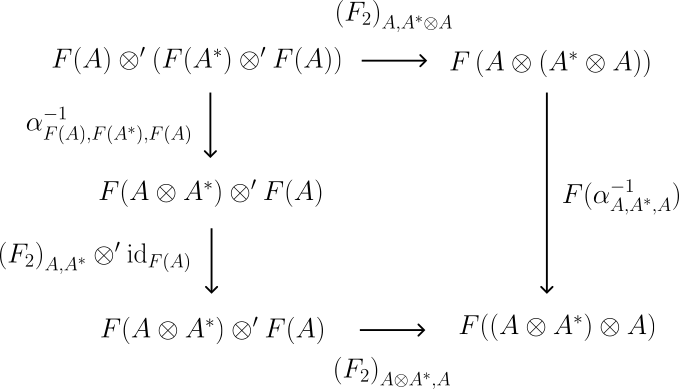
The fourth is again naturality
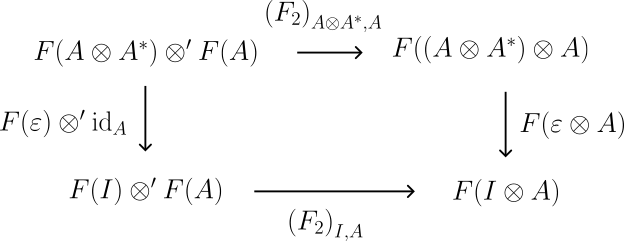
And the final one is the monoidal functor axiom
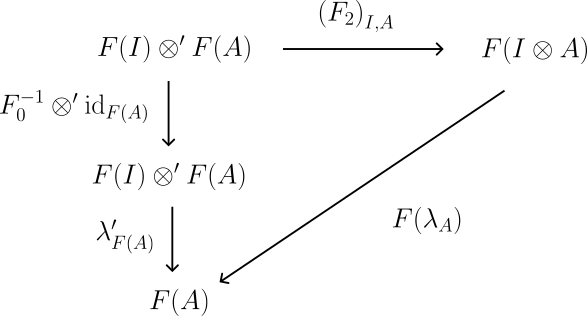
Together, and ignoring the interior arrows, we have
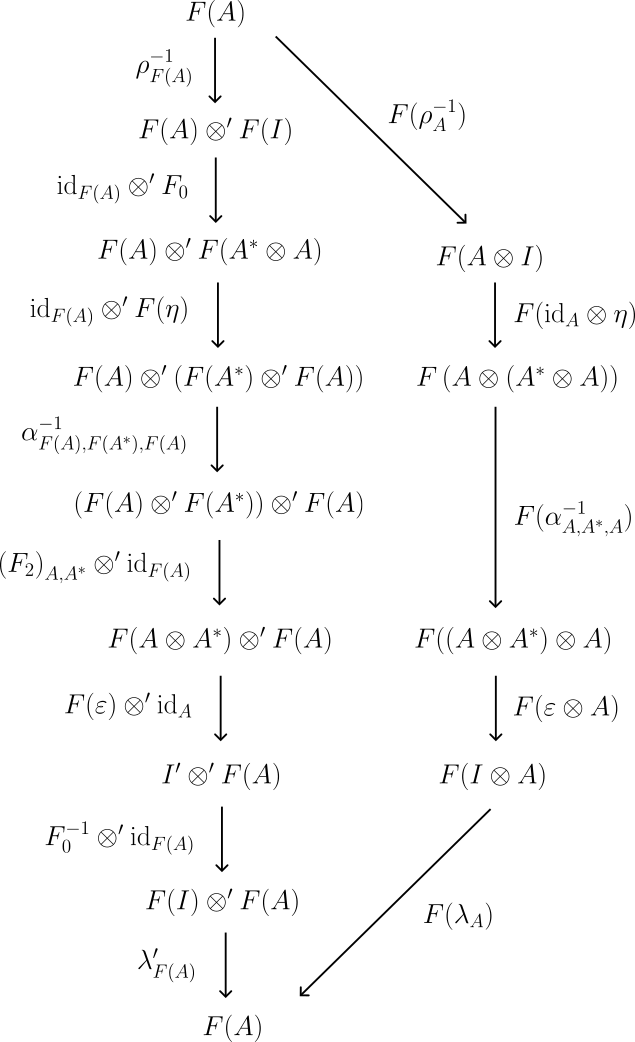
If we define \(\eta'=\left(F_{2}\right)_{A^{*},A}^{-1}\circ F(\eta)\circ F_{0}:I'\to F(A^{*})\otimes F(A)\) and \(\varepsilon'=\left(F_{0}\right)^{-1}\circ F(\varepsilon)\circ\left(F_{2}\right)_{A,A^{*}}:F(A)\otimes F(A^{*})\to I'\), then the left hand side is the snake equation in \(\boldsymbol{C}'\) in terms of \(\eta'\) and \(\varepsilon'\). The right-hand side is the snake equation in \(\boldsymbol{C}\)in terms of \(\eta\) and \(\varepsilon\), under the image of \(F\).
Then, since functors preserve identities, the right-hand side is the identity in \(\boldsymbol{C}'\), which establishes the first snake equation. The other snake equation is proven similarly.
Theorem
Let \(\boldsymbol{C}\) and \(\boldsymbol{D}\) be monoidal categories, and let \(F,G:\boldsymbol{C}\to\boldsymbol{D}\) be monoidal functors. Let \(\mu:F\Rightarrow G\) be a monoidal natural transformation. Let \(A\in\text{Ob}(\boldsymbol{C})\) have a right or left dual. Then, \(\mu_{A}:F(A)\to G(A)\) is invertible.
Lemma (Double dual functor is monoidal)
Let \(\boldsymbol{C}\) be a category with chosen right duals for the objects. The double dual functor \(\left(\cdot\right)^{**}:\boldsymbol{C}\to\boldsymbol{C}\) is monoidal.
More to come
Next post I will introduce the fundamental notions of pivotal and ribbon categories, still following the approach of Heunen and Viacary and finishing with this book for a while, as we will reach the end of chapter 3.