
In this fourth post I will finish Chapter 3 of Chris Heunen and Jamie Vicary's Categories for Quantum Theory. Here I will introduce the series of additional types of categories stemming from the presence of duals. This includes pivotal categories which are equipped with monoidal natural transformations from objects to their double duals, i.e. have an identification between taking the dual of the dual, and doing nothing. Another important structure I'll introduce today is that of balanced monoidal categories which are equipped with the ability to “twist ” wires, as well as ribbon categories, for which wires behave rather as ribbons in 3D space.
Pivotal and Balanced Categories
Definition (Pivotal category)
A monoidal category with right duals is pivotal when it is equipped with a monoidal natural transformation \(\pi_{A}:A\to A^{**}\).
In particular, \(\pi_{A}\) must satisfy
where \(\phi_{A,B}\) and \(\psi:I\to I^{**}\) are the canonical isomorphisms arising from the double dual lemma.
Lemma (Invertibility of \(\pi_{A}\))
In a pivotal category, the morphisms \(\pi_{A}:A\to A^{**}\) are invertible.
Observation
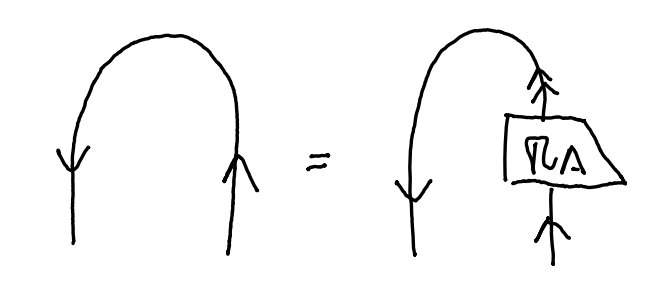
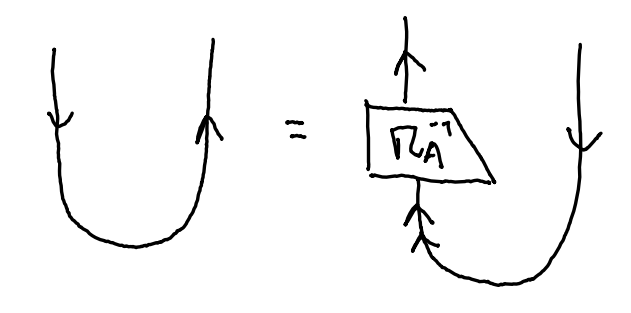
In a pivotal category, one has additional cups and caps
Lemma (Sliding)
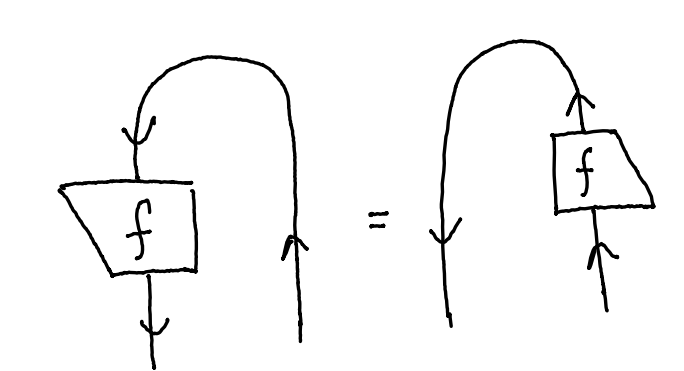
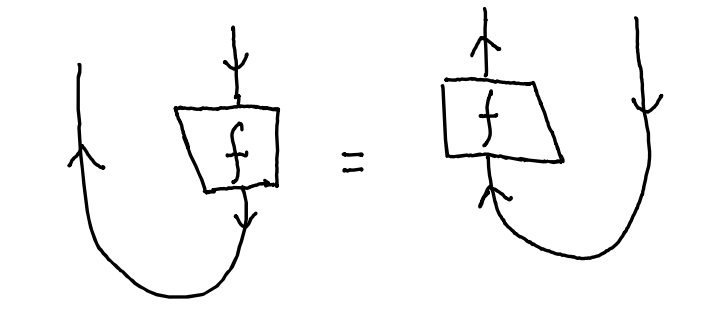
In a pivotal category, for all morphisms \(f:A\to B:\)
Proof
The proof of the sliding theorem proceeds graphically as
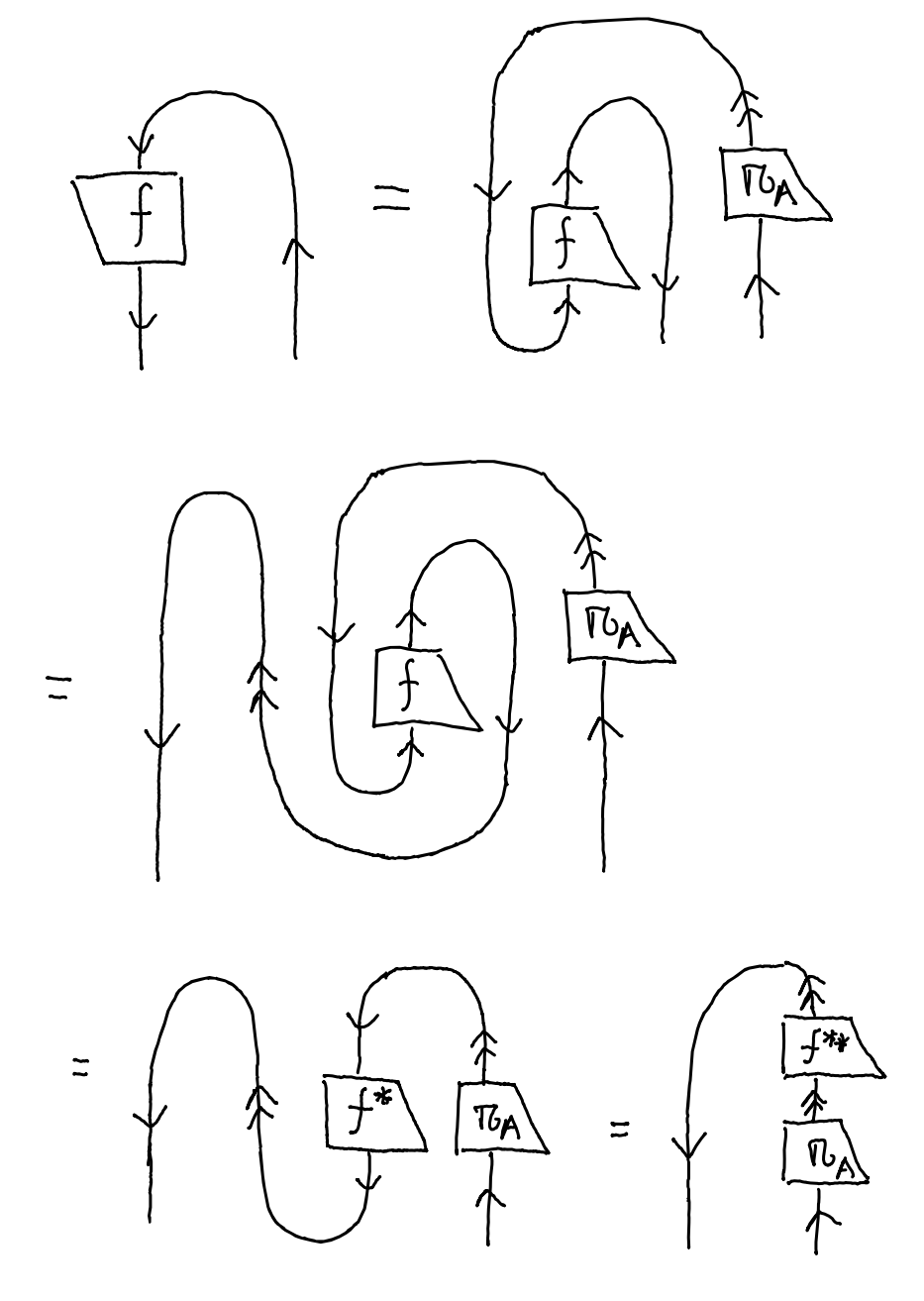
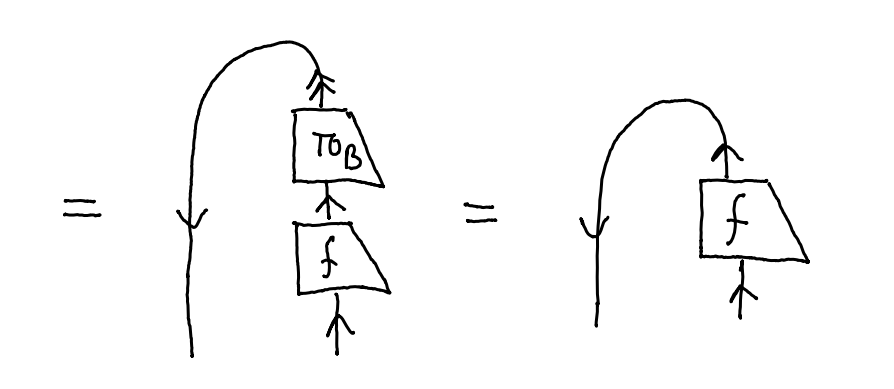
The other equality is proved analogously.
Observation
A pivotal structure essentially says that taking right duals twice is equivalent to doing nothing. However, since taking left and right duals are inverse processes, then a pivotal structure can also be interpreted as an equivalence between left duals and right duals.
Theorem (Left duals exist in a pivotal category)
In a pivotal category, every object has a left dual.
Proof
Due to the existence of the morphism \(\pi_{A}\), we have
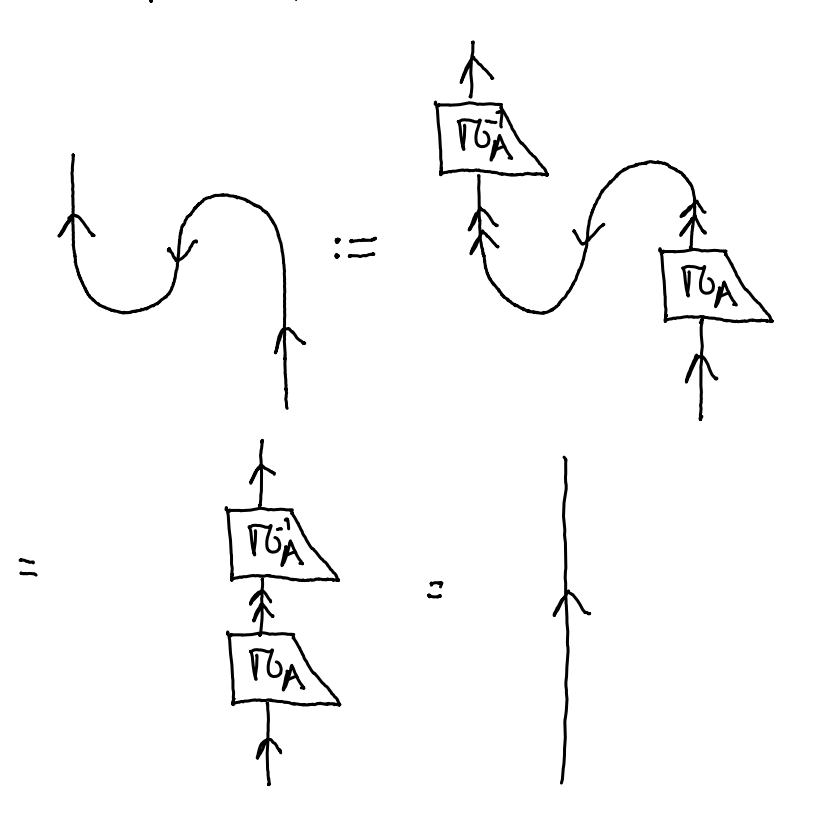
The other axiom for left duality is proved similarly.
Theorem (Correctness of the graphical calculus for a pivotal category)
In a pivotal category, a well-formed equation between morphisms follows from the axioms if and only if it holds in the graphical language up to planar oriented isotopy.
The key new feature of this correctness theorem is the word oriented, i.e. a valid isotopy must preserve the arrows in the wires of any diagram.
Observation
In the presence of a braiding, pivotal structure can be expressed in terms of a twist. This pushes us to the concept of a balanced monoidal category.
Definition (Balanced monoidal category)
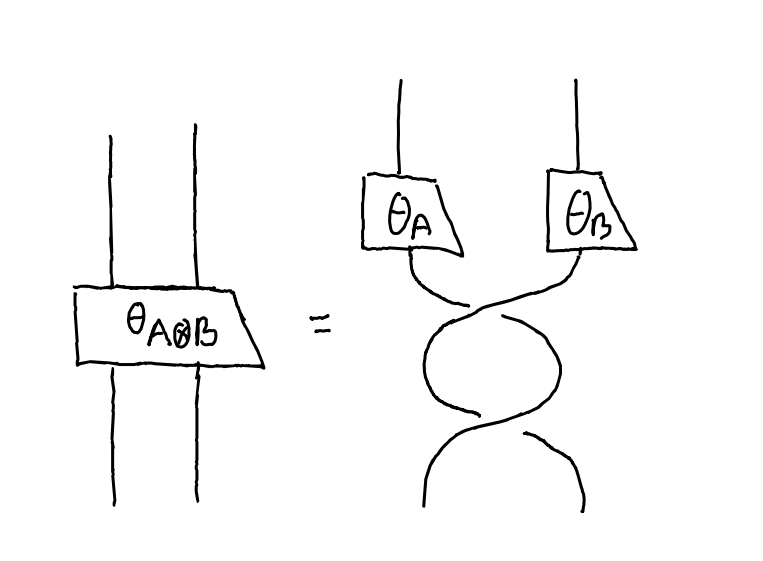
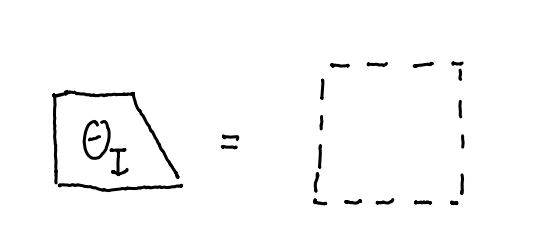
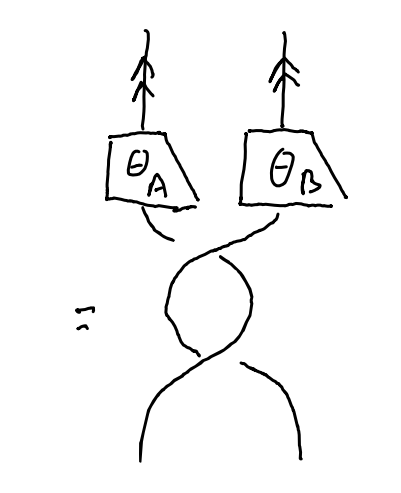
A braided monoidal category is called balanced when it is equipped with a natural isomorphism \(\theta_{A}:A\to A\) called a twist, satisfying the equations
Observation
Every symmetric monoidal category admits the trivial twist \(\theta_{A}=\text{id}_{A}\).
Theorem (Equivalence of pivotality and balance in braided monoidal categories)
In a braided monoidal category with right duals, a pivotal structure uniquely induces a twist structure, and vice-versa.
Proof
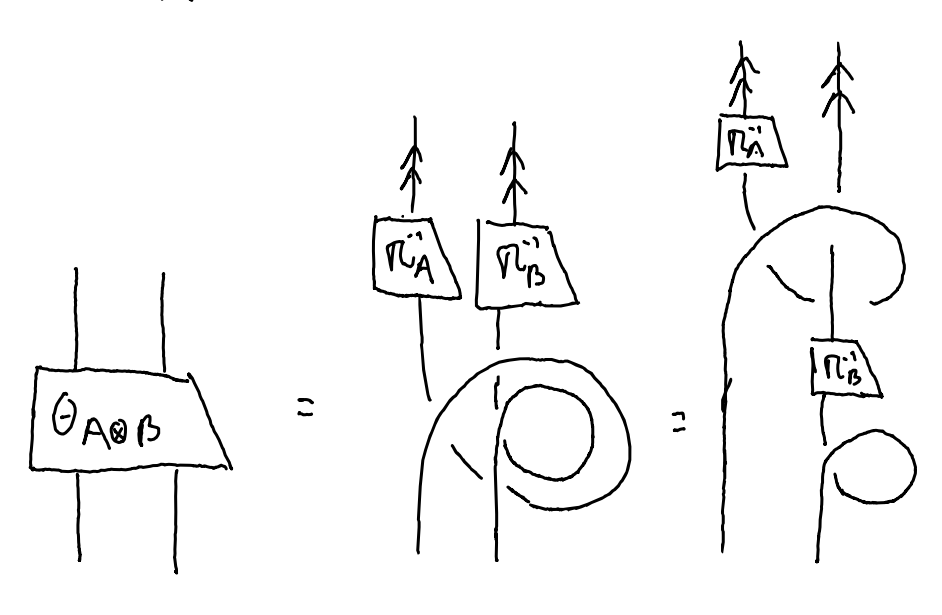
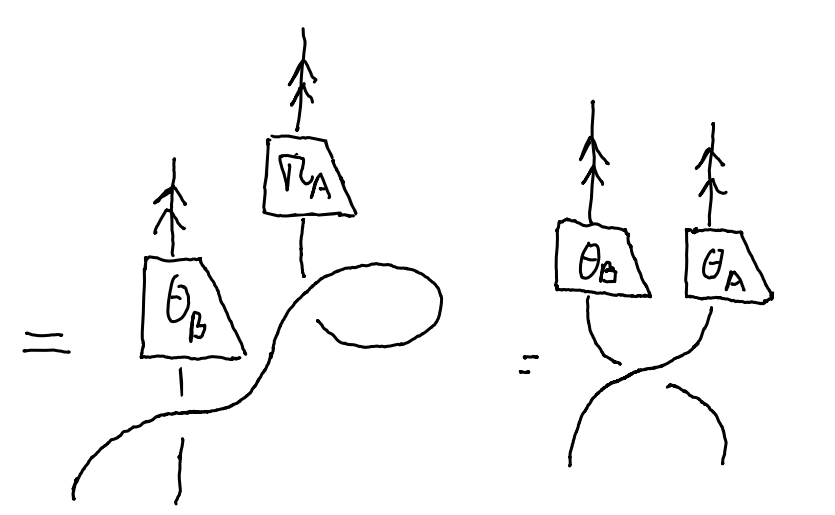
Givevn right duals for every object \(A\), and a twist structure \(\theta_{A}\), we can define the following pivotal structure \(\pi_{A}\)
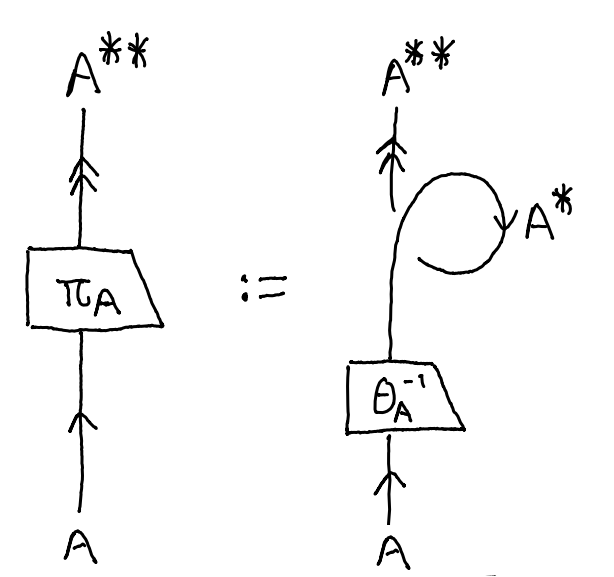
\(\pi_{A}\) is by construction a morphism from \(A\) to \(A^{**}\). To show that it is a pivotal structure, it then suffices to show that it is natural and monoidal. Let's first show that it is a monoidal transformation
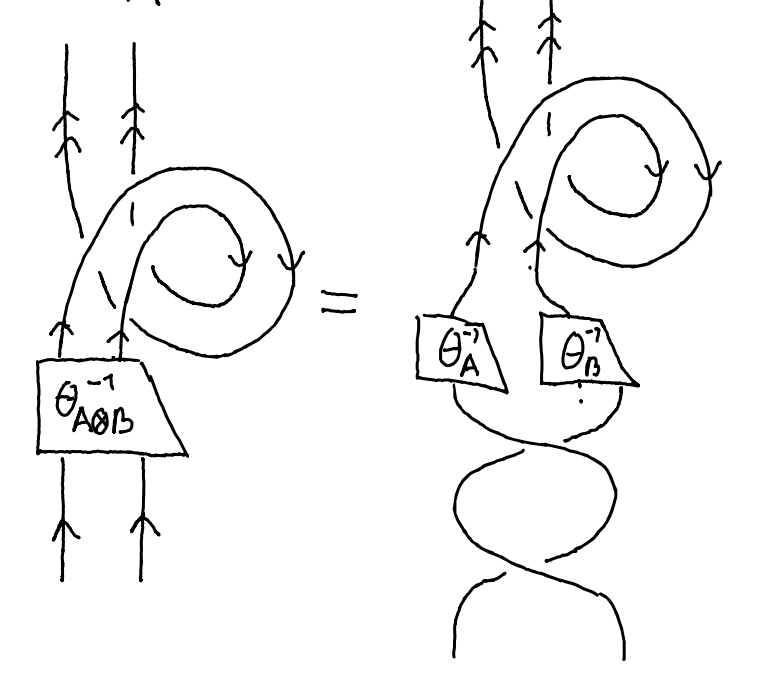
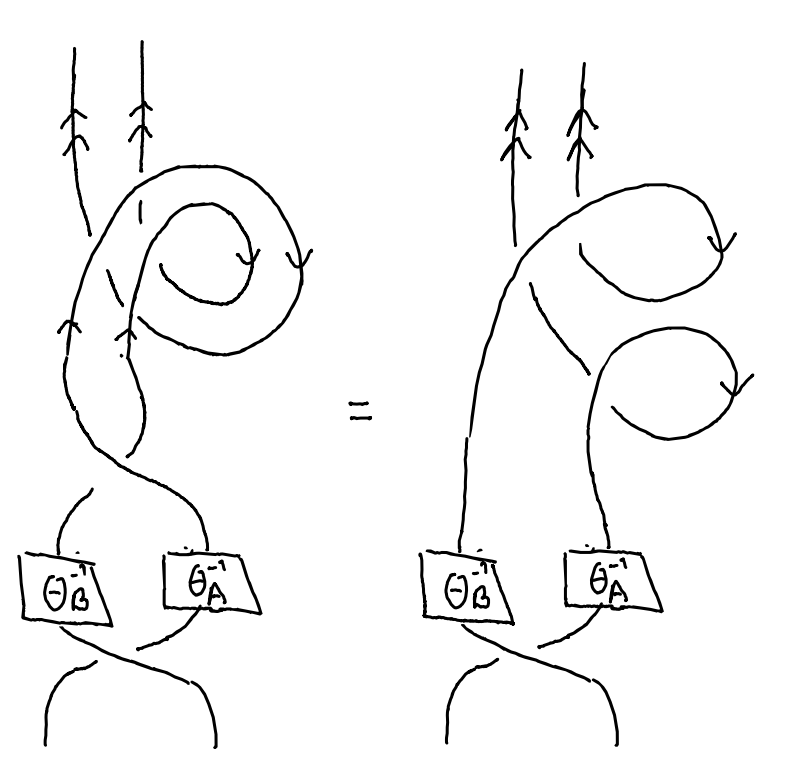
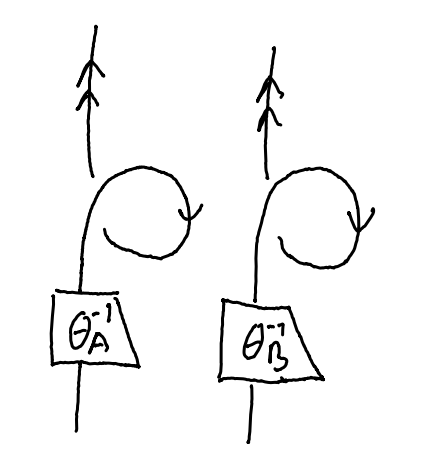
Now let's show that it is a natural transformation
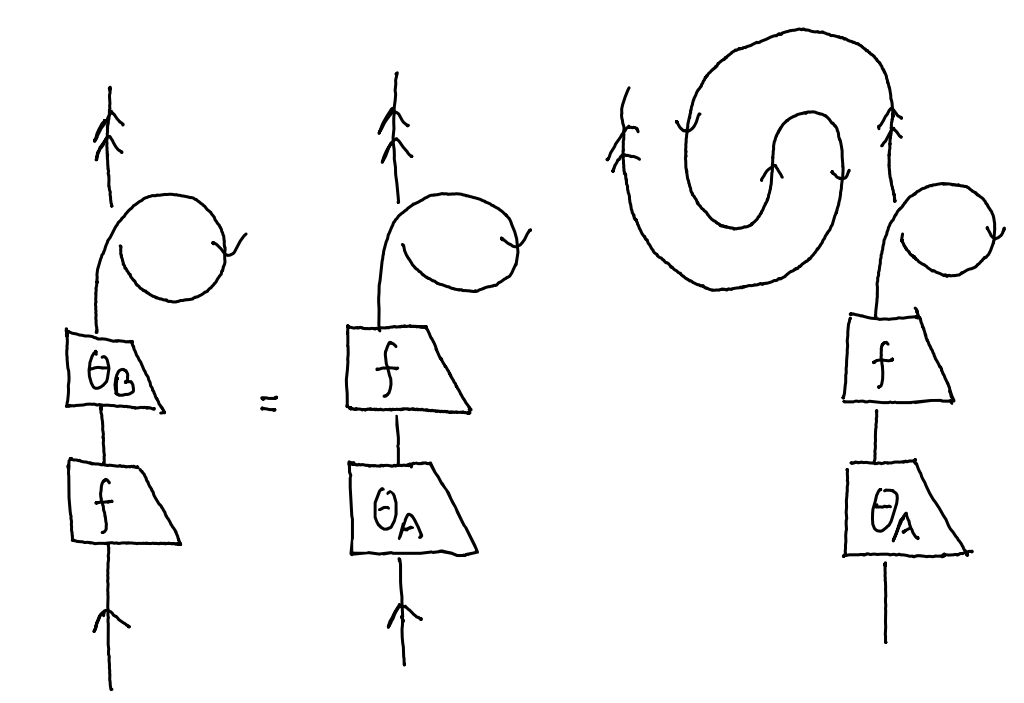
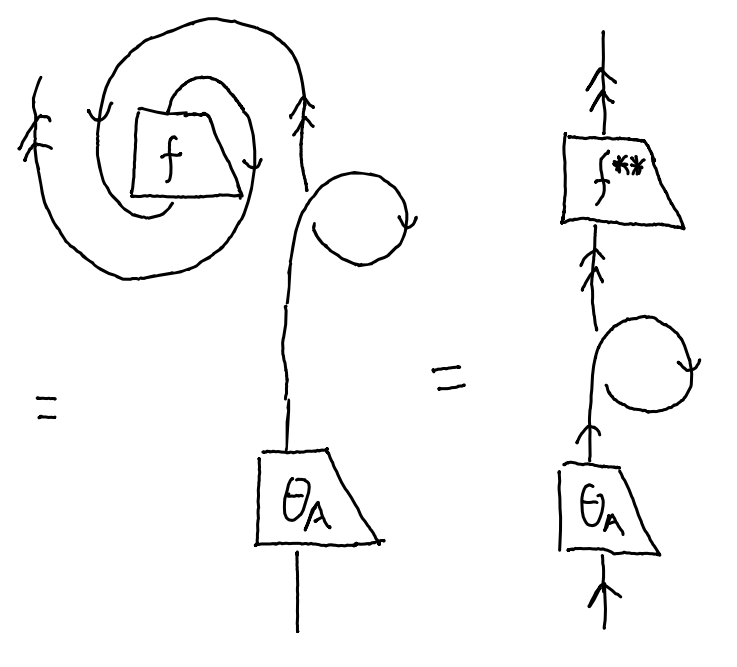
Conversely, given a pivotal structure \(\pi_{A}\), a balanced structure, or a twist, can be defined as
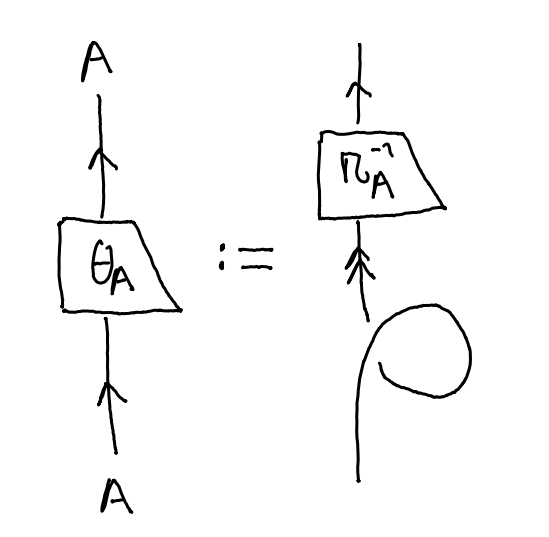
We then have to prove the balanced equation, which we can do by expanding
Definition (Compact category)
A compact category is a pivotal symmetric monoidal category where the canonical twist is the identity \(\theta_{A}=\text{id}_{A}\).
Observation
Any symmetric monoidal category in which every object has a right dual is compact in a canonical way.
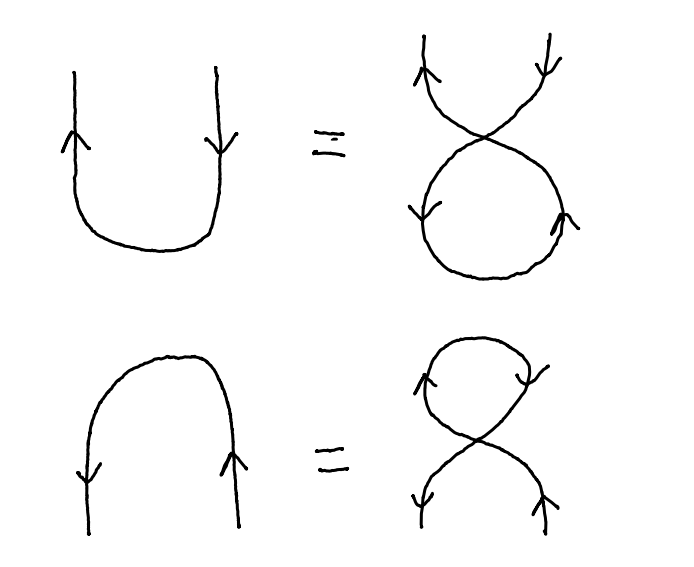
Lemma
In a compact category, the following equations hold
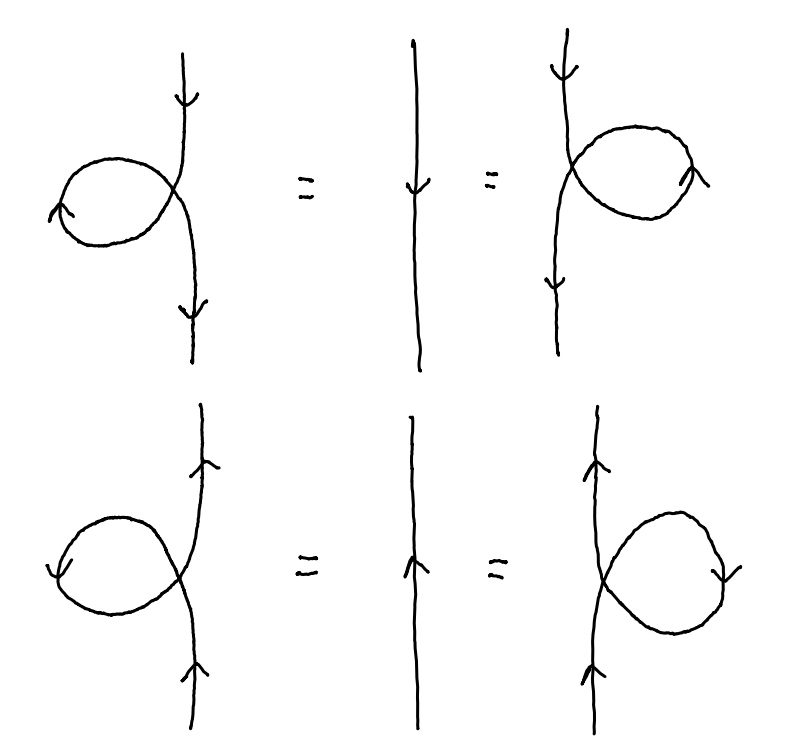
Proof
Let us prove some the second equality in a diagrammatic fashion. We have
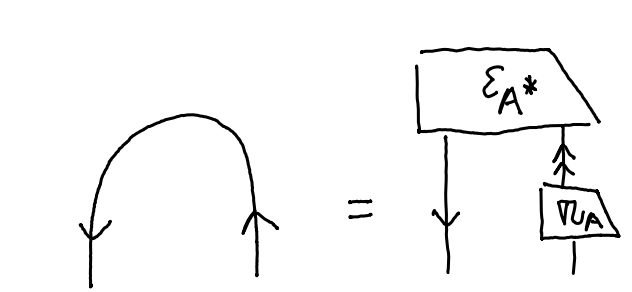
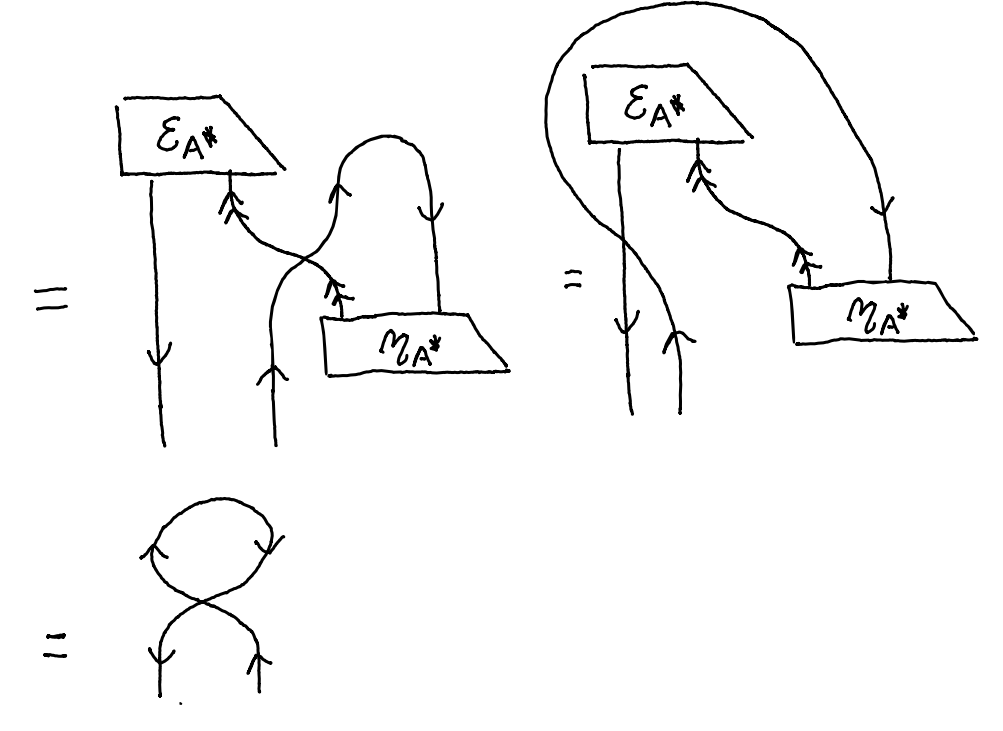
Proofs for the other equalities can be similarly obtained.
Ribbon Categories
When using the graphical calculus for braided pivotal categories, one must be careful with loops on a single strand. Indeed, the correctness of the graphical calculus does not imply that a loop must equal the identity, and this is because the correctness theorem only allows for planar oriented isotopy, not spatial oriented isotopy.
Therefore loops cannot be generically removed. In fact, a loop on a single strand is related to the twist.
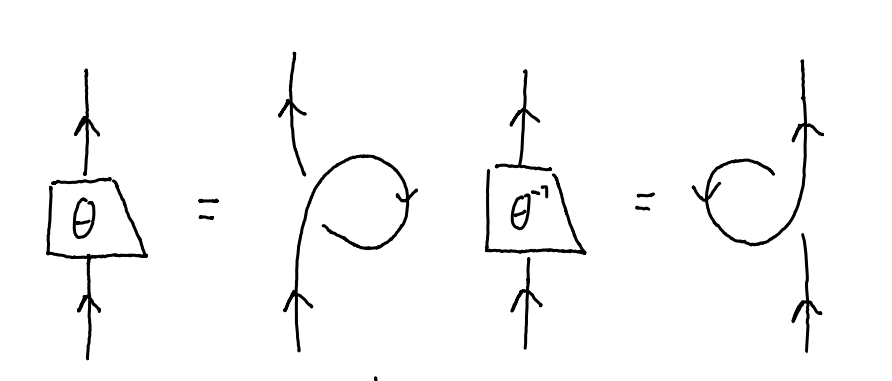
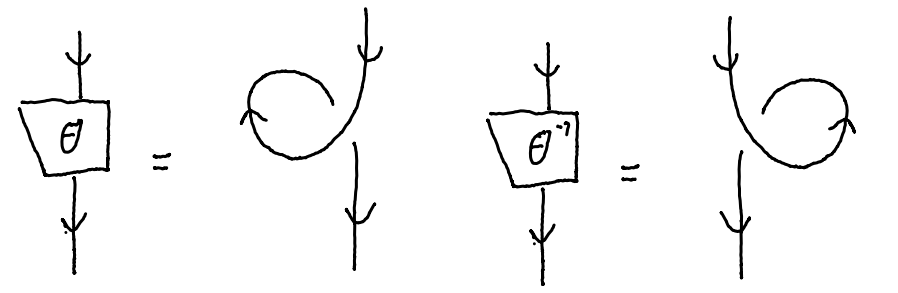
Lemma (Loop = Twist)
In a braided pivotal category, the following equations hold
Proof
The first equality stems directly from the definition of the twist in terms of the pivotal structure. The equation for \(\theta^{-1}\) can be verified by computing
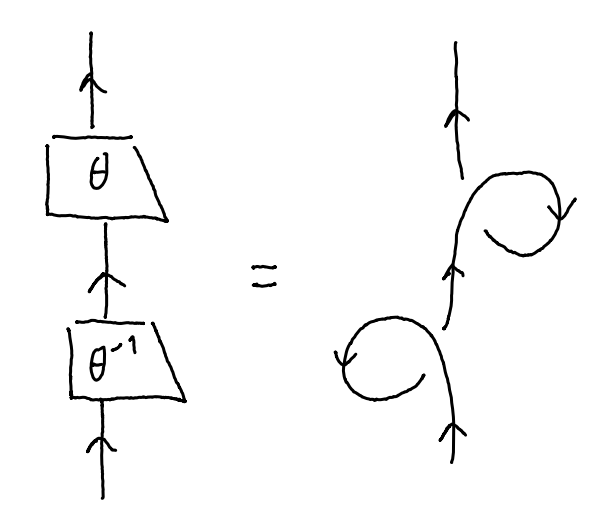
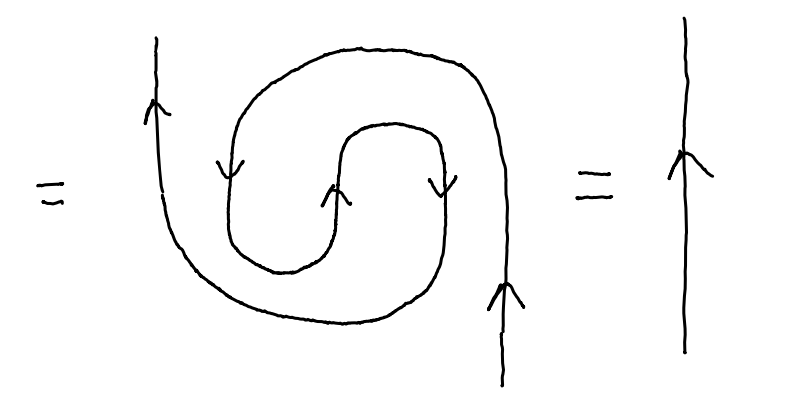
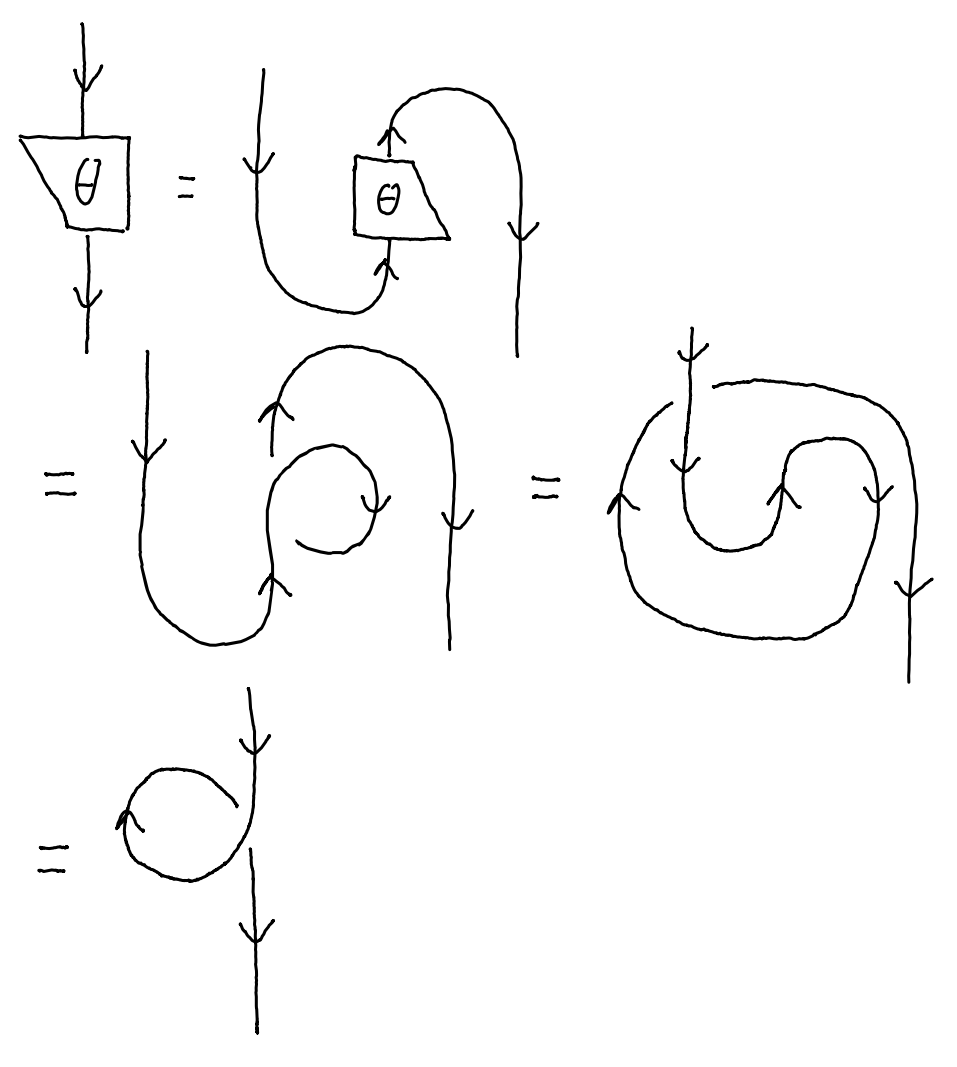
Due to the uniqueness of inverses in a category, the expression for \(\theta\) must be correct. As for the graphical form of \(\theta^{*}\), we have
Definition (Ribbon category)
A ribbon category is a balanced monoidal category with duals, such that \(\left(\theta_{A}\right)^{*}=\theta_{A^{*}}\).
Lemma
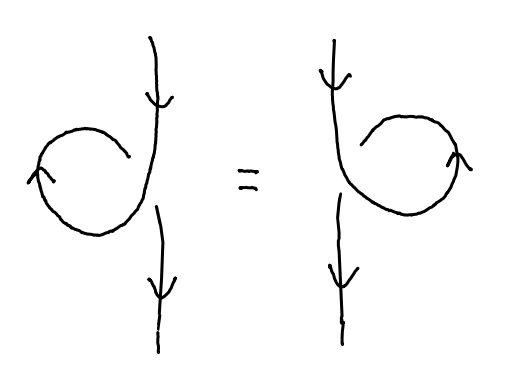
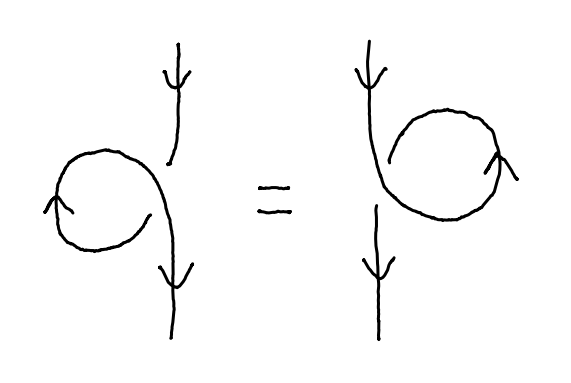
A balanced monoidal category is a ribbon category if and only if either of the following equations are satisfied
Proof
This follows directly from the definition of the twist in a braided pivotal category as given above.
Lemma
A compact category is a ribbon category.
Lemma
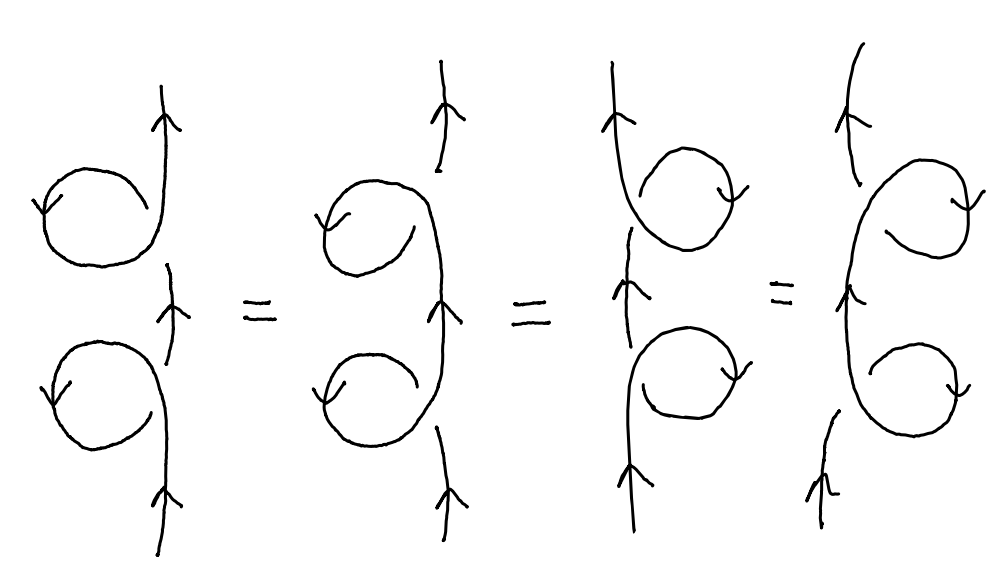
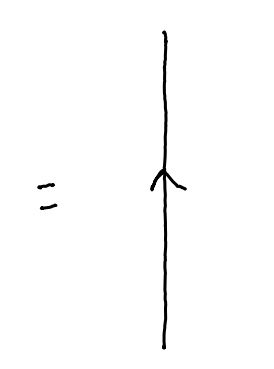
In a ribbon category, the following equations hold
Proof
All of these equalities are consequences of the definitions of \(\theta\), \(\theta^{*}\), \(\theta^{-1}\) and \(\left(\theta^{-1}\right)^{*}\).
Observation
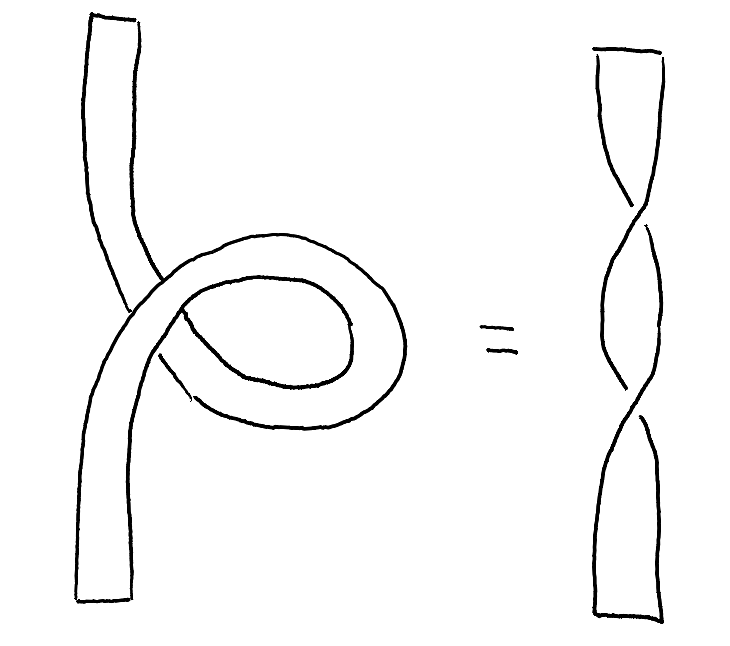
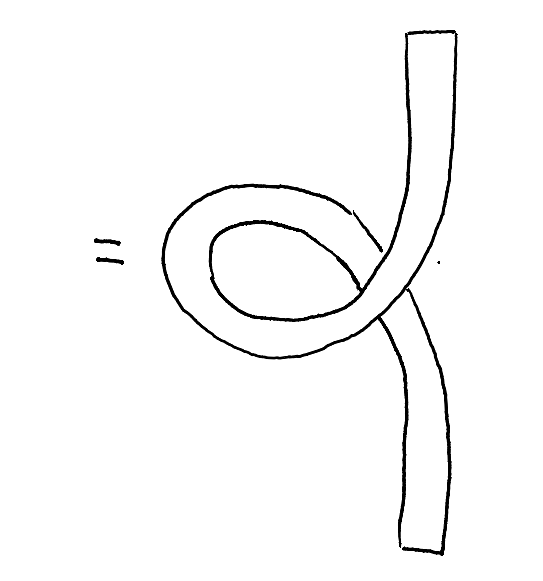
These are the equations we would expect to be satisfied by ribbons in an ambient 3D space. This is made precise by the correctness theorem for ribbon categories.
Theorem (Correctness of the graphical calculus for ribbon categories)
A well formed equation between morphisms in a ribbon category follows from the axioms if and only if it holds in the graphical language up to framed isotopy in 3D. Framed isotopy means that strands are thought of as ribbons rather than wires.
Lemma
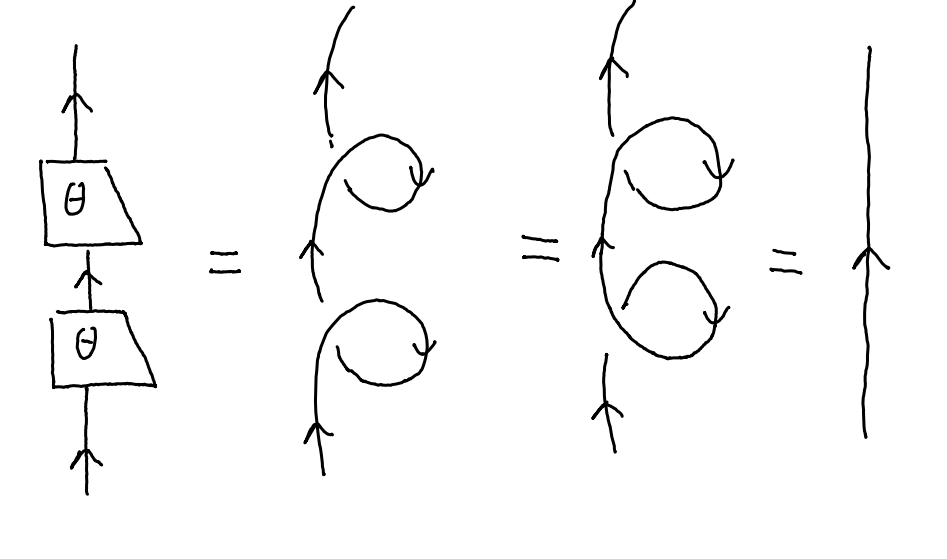
In a symmetric ribbon category \(\theta\circ\theta=\text{id}\).
Proof
Graphically, we have
Dagger duality
Lemma
In a monoidal dagger category \(L\dashv R\Leftrightarrow R\dashv L\).
Proof
This follows directly from the axiom \(\left(f\otimes g\right)^{\dagger}=f^{\dagger}\otimes g^{\dagger}\) for monoidal dagger categories.
Definition (Dagger dual)
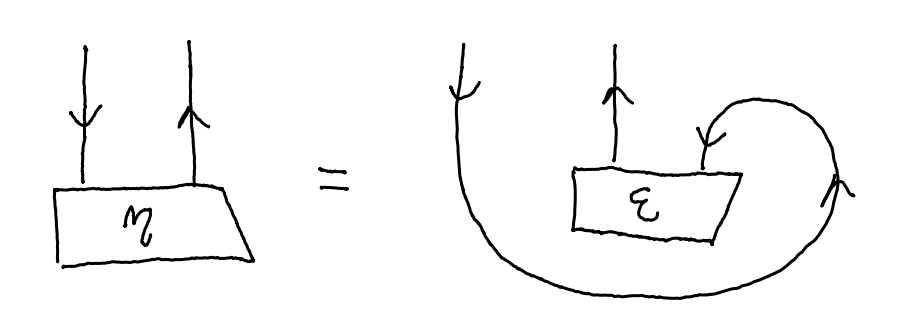
In a dagger category with a pivotal structure, a dagger dual is a duality \(A\dashv A^{*}\) witnessed by morphisms \(\eta:I\to A^{*}\otimes A\) and \(\varepsilon:A\otimes A^{*}\to I\) that satisfy
Lemma
In a dagger pivotal category with a pivotal structure, dagger duals are unique up to unique unitary isomorphism.
Proof
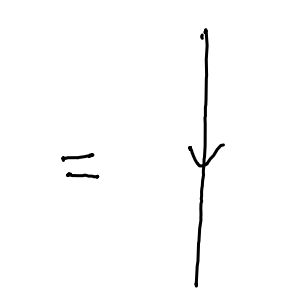
Given dagger duals \(\left(L\dashv R,\eta,\varepsilon\right)\) and \(\left(L\dashv R',\eta',\varepsilon'\right),\) we have the isomorphism \(R\simeq R'\) given by
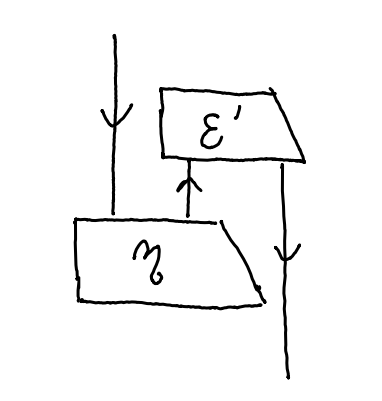
Then, we can show that this is a co-isometry as
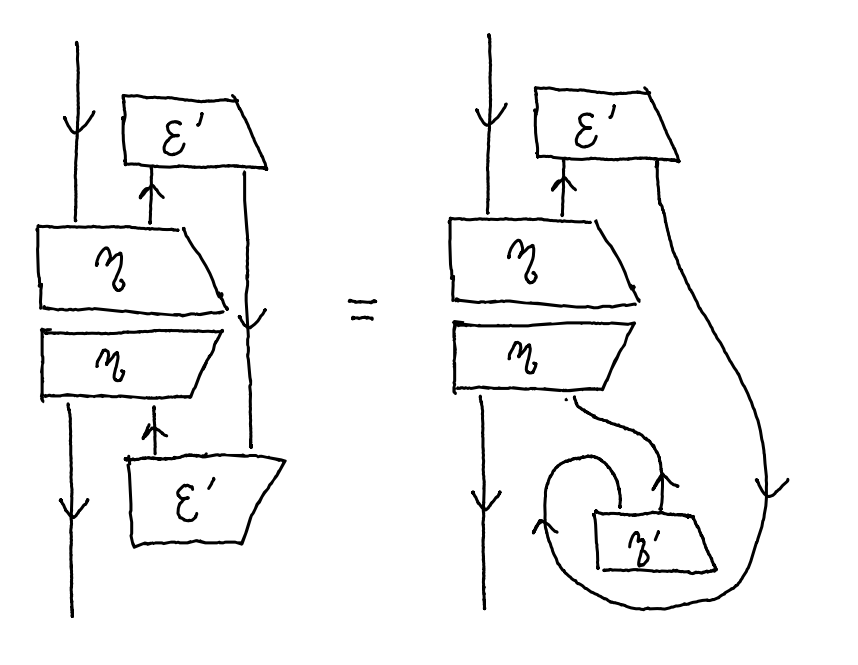
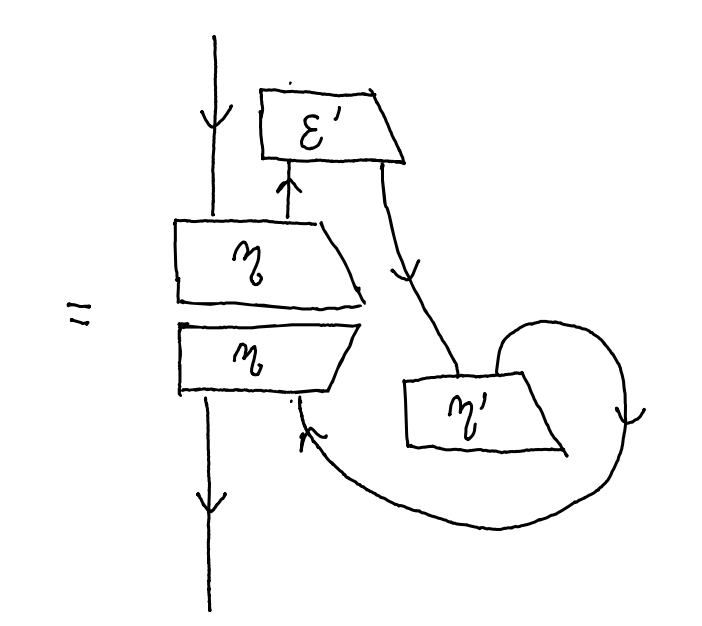
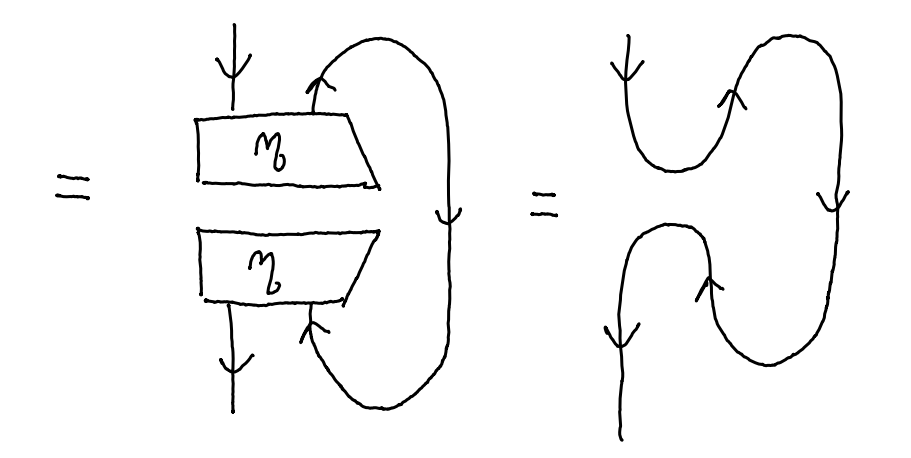
Definition (Dagger pivotal category)
A dagger pivotal category is a monoidal category with a pivotal structure, such that the chosen right duals are all dagger duals.
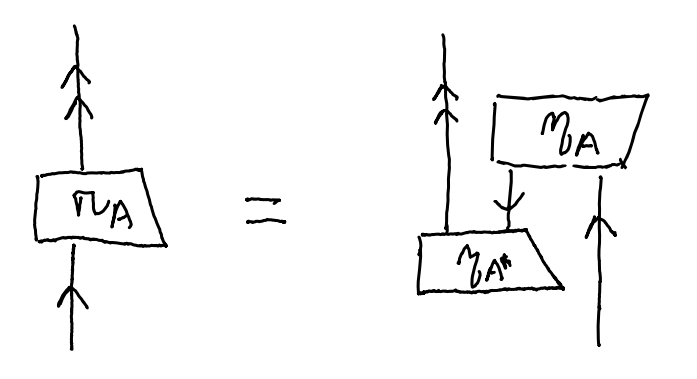
Proposition
The pivotal structure in a dagger pivotal category is given by the composite
Proof
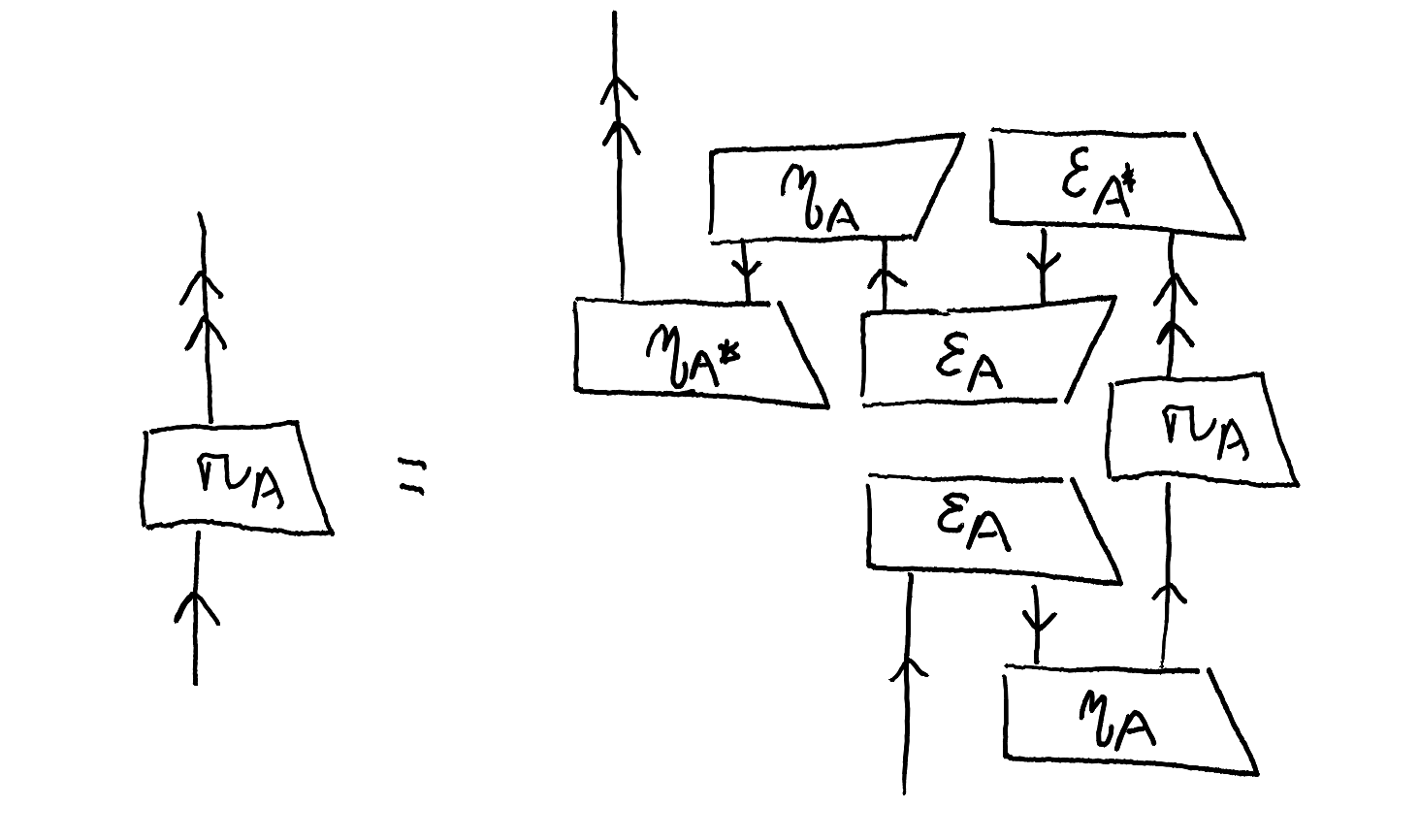
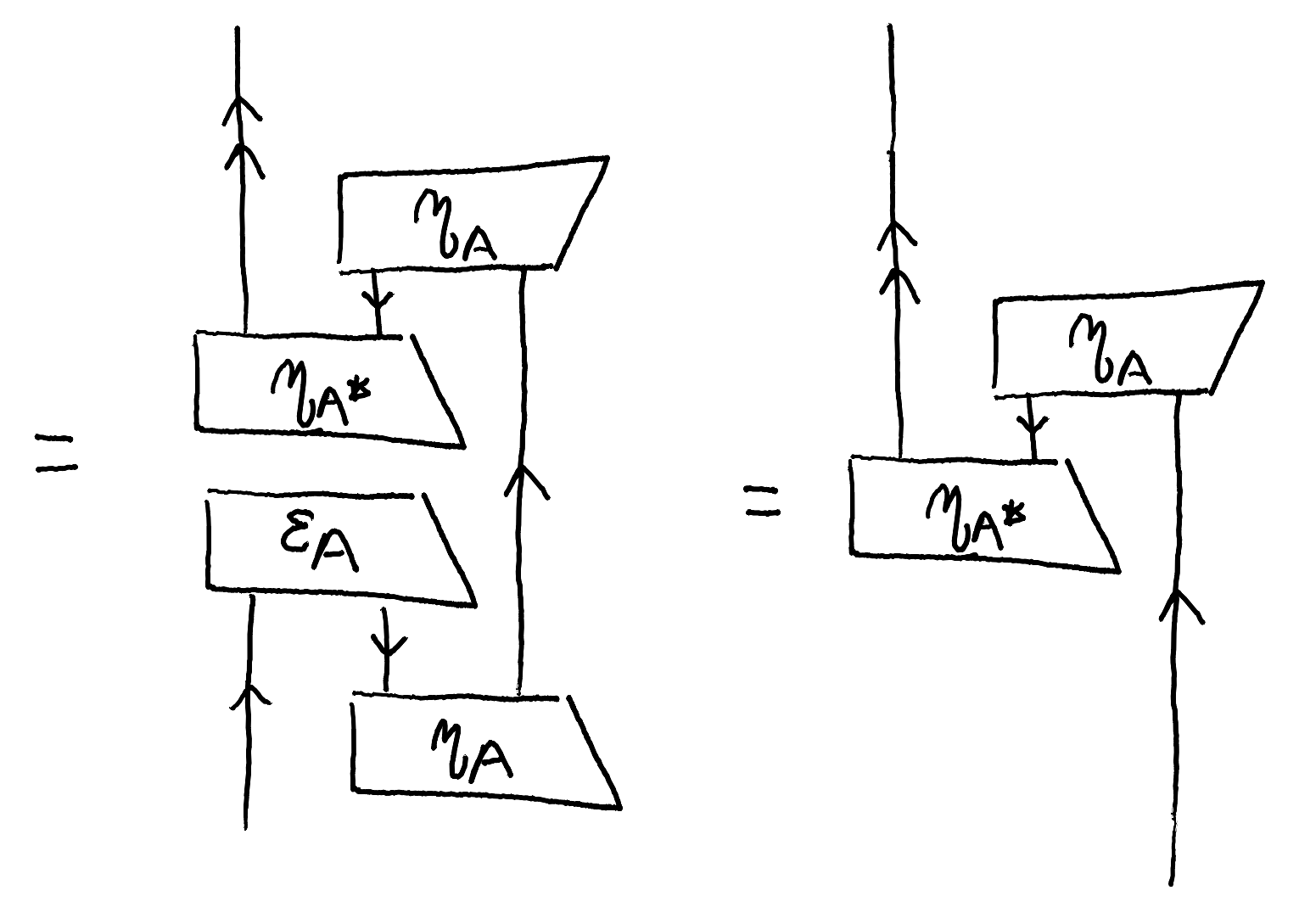
The proof proceeds graphically as
Proposition
In a dagger pivotal category, the pivotal structure is unitary
Proof
Using the canonical isomorphism \(\phi_{A,A^{*}}\), we can write
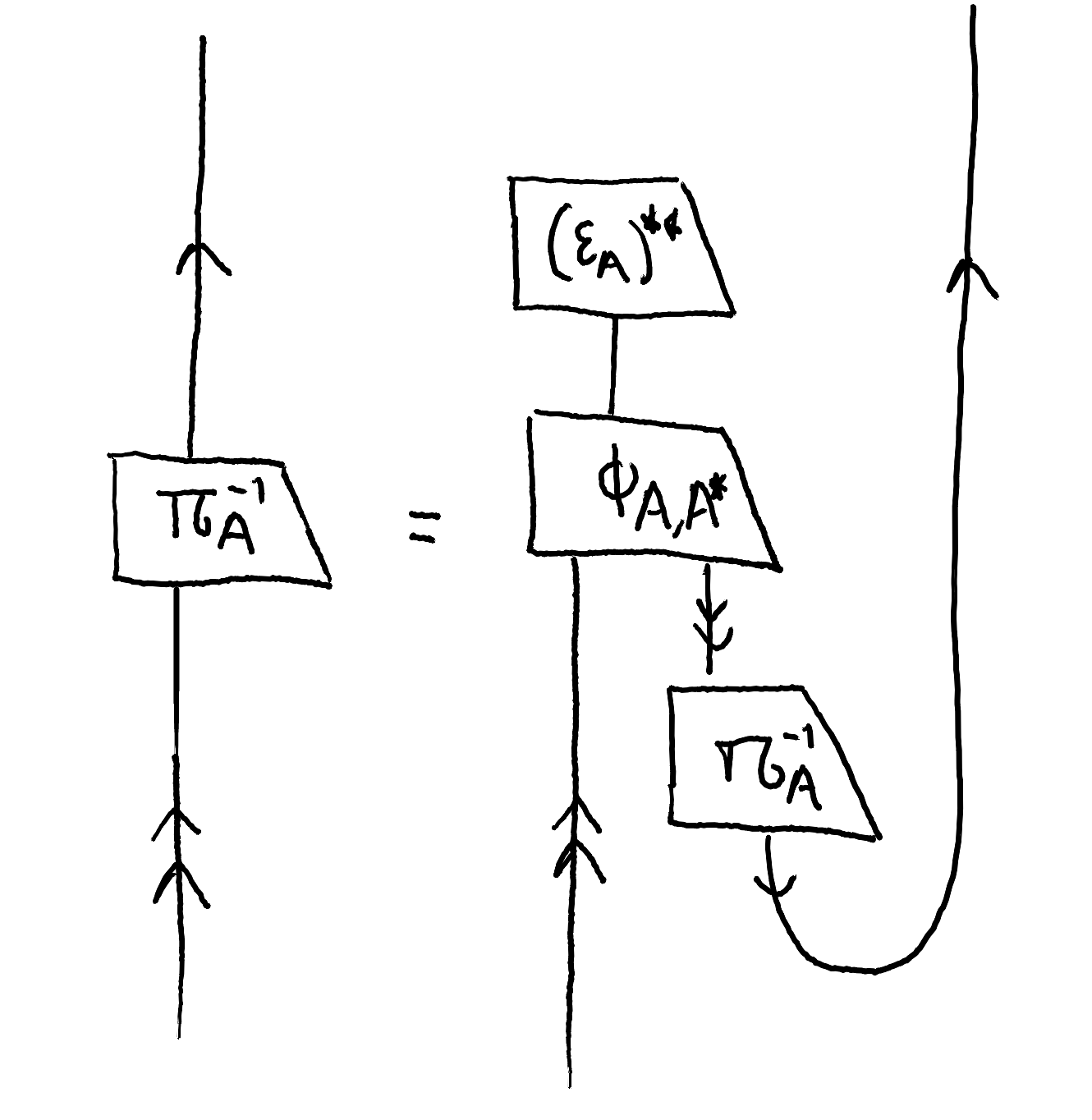
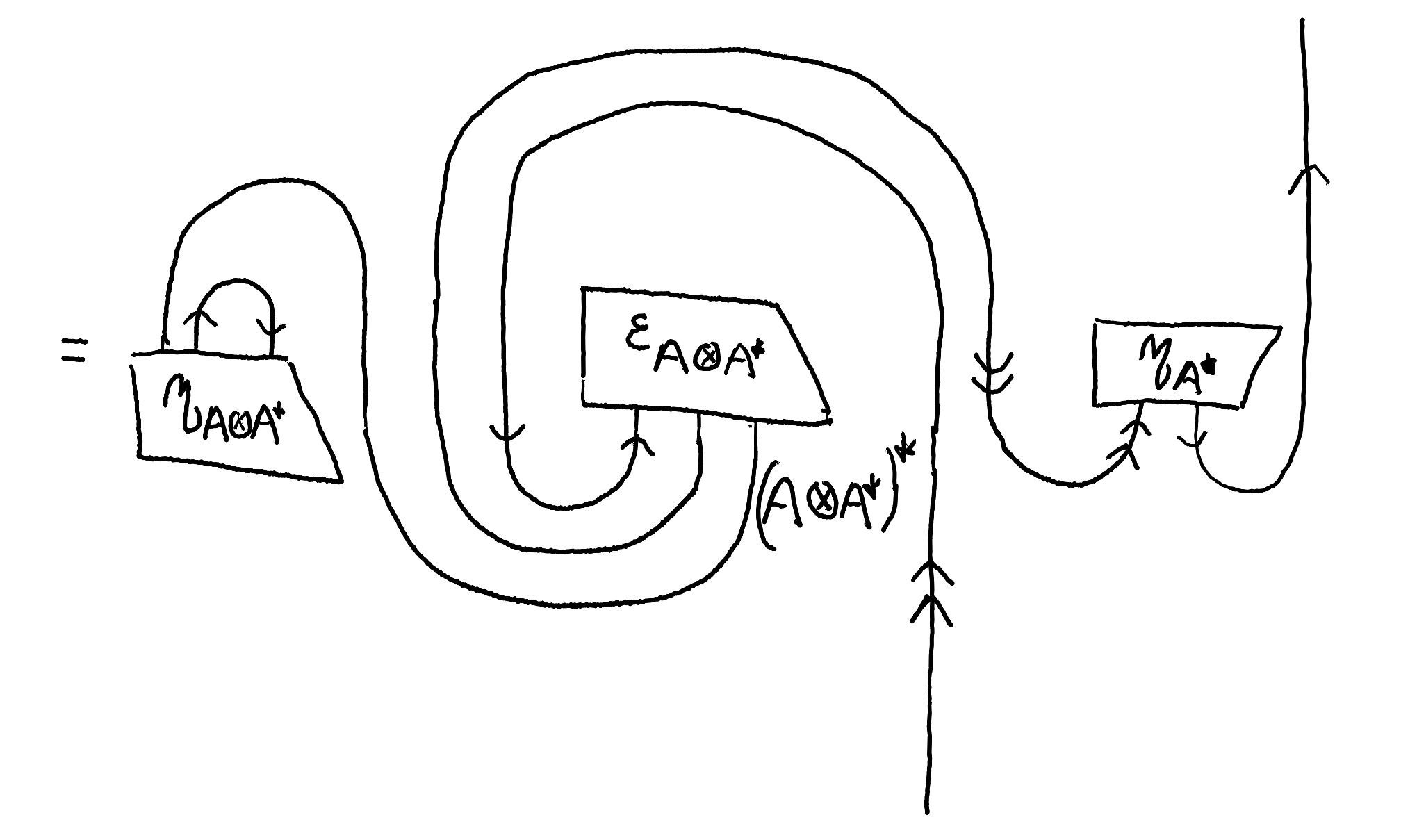
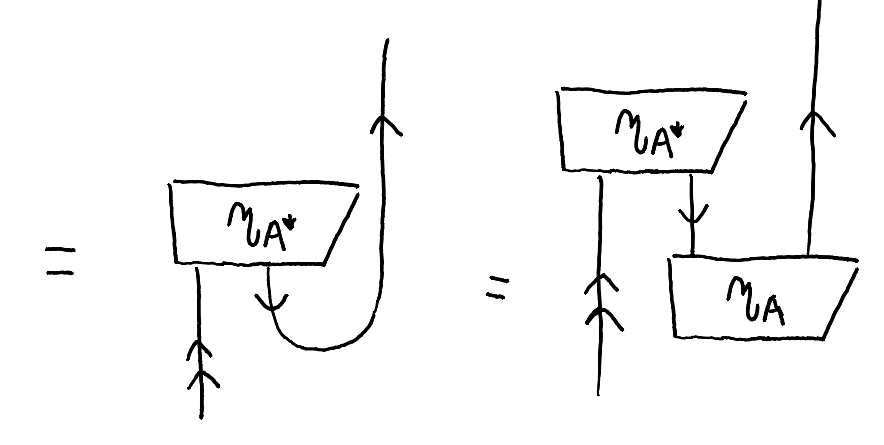
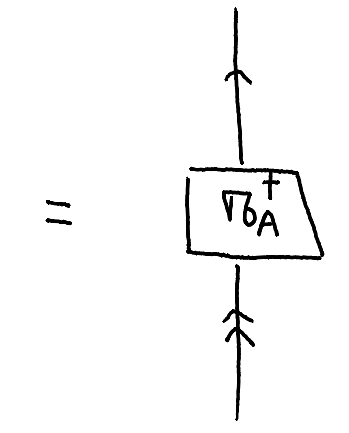
which completes the proof.
Observation
Dagger pivotal categories have a graphical calculus where the dagger acts as reflection along a horizontal axis.
Lemma
In a dagger pivotal category, the following equations hold
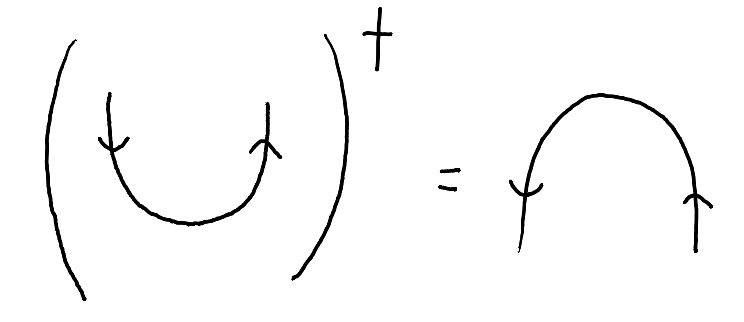
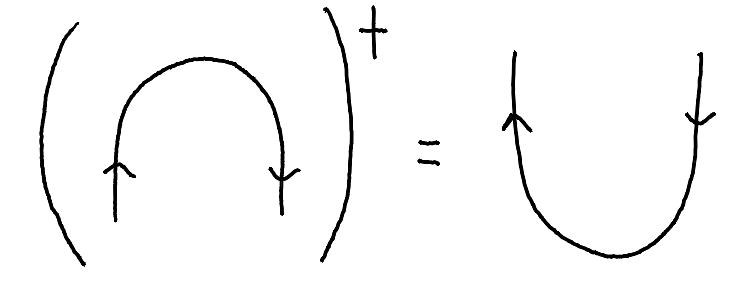
Proof
We proceed graphically as
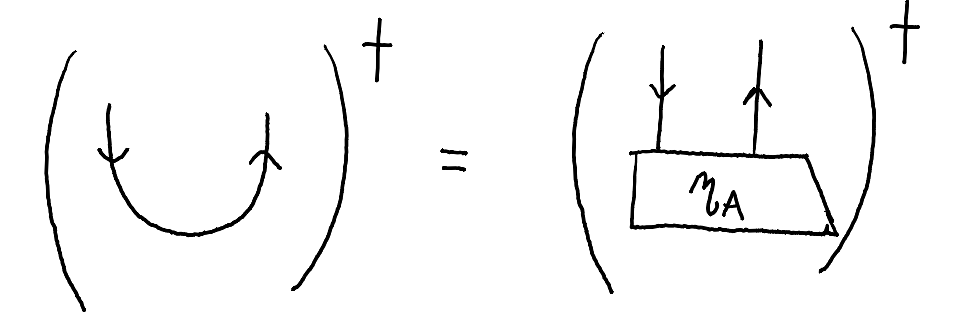
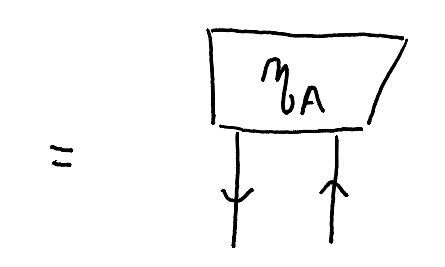
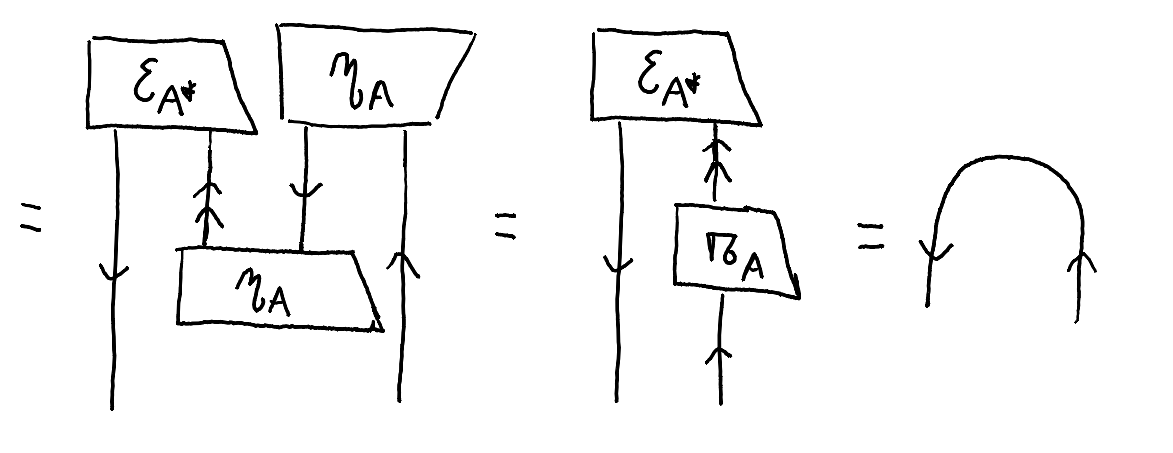
The second equation follows by the fact that the cup determines the cap, proved in the previous blog post.
Lemma (The dagger and dual functors commute)
In a dagger pivotal category, every morphism \(f\) satisfies \(\left(f^{*}\right)^{\dagger}=\left(f^{\dagger}\right)^{*}\).
Proof
We can compute both sides
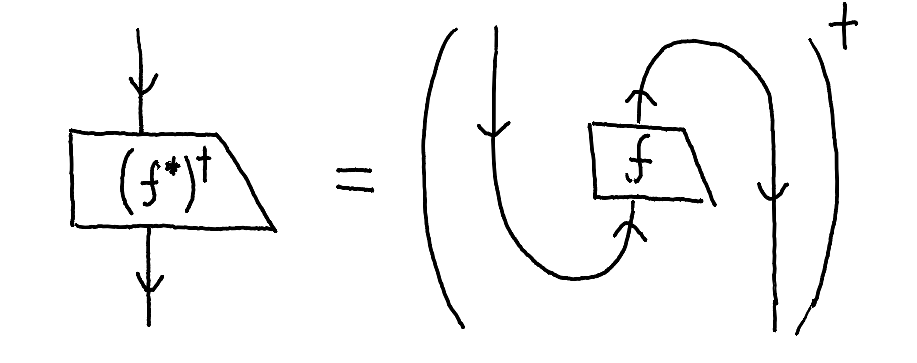
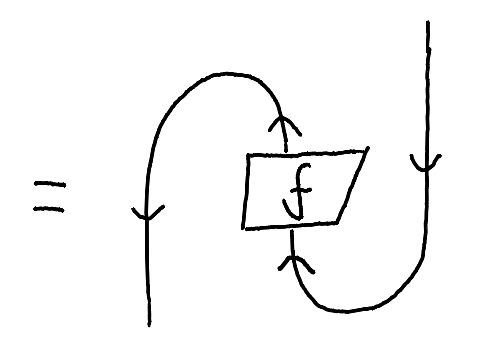
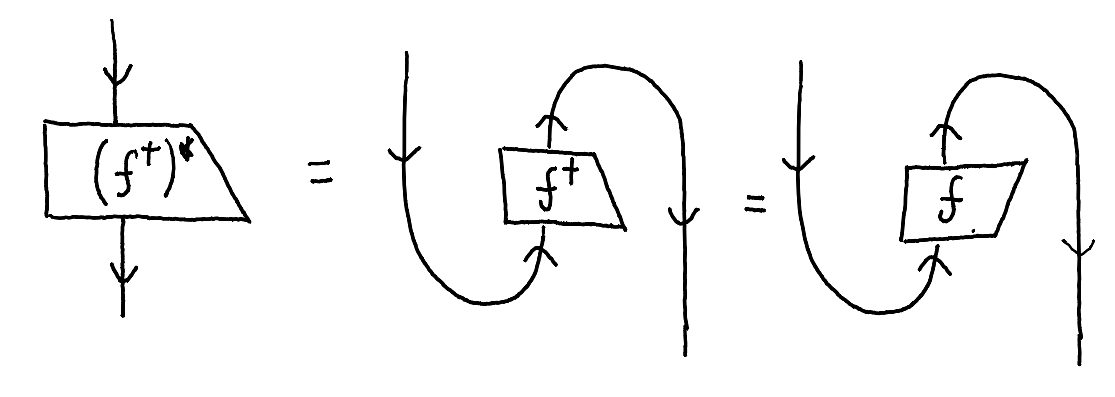
And since the results are isotopic, then we have proved the equality.
Definition (Conjugation)
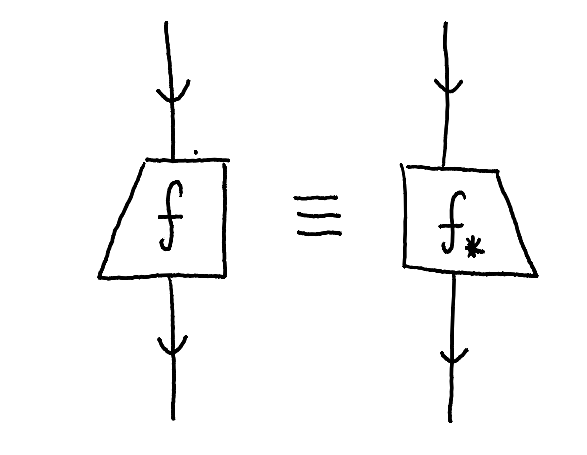
On a dagger pivotal category, conjugation \(\left(\cdot\right)_{*}\) is the composite of the dagger functor and the right-dual functor
\[\begin{equation} \left(\cdot\right)_{*}:=\left(\cdot\right)^{*\dagger}=\left(\cdot\right)^{\dagger*}. \end{equation}\]
Observation
Conjugation is denoted graphically by reflection along a vertical axis.
Definition (Ribbon dagger category)
A ribbon dagger category is a braided dagger pivotal category with unitary braiding and twist.
Definition (Compact dagger category)
A compact dagger category is a symmetric dagger pivotal category with unitary symmetry and \(\theta=\text{id}\).
Traces
Definition (Trace)
In a pivotal category, the trace of a morphism \(f:A\to A\) is the following scalar
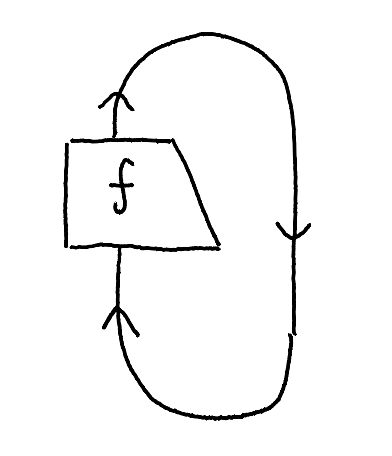
It is denoted by \(\text{tr}\left(f\right)\) or \(\text{tr}_{A}\left(f\right)\).
Definition (Dimension)
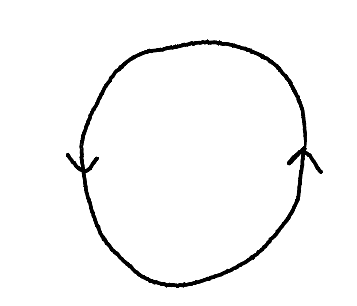
The dimension of an object \(A\) is the scalar \(\dim A=\text{tr}\left(\text{id}_{A}\right)\). Graphically it reads
Lemma (Cyclic property of the trace)
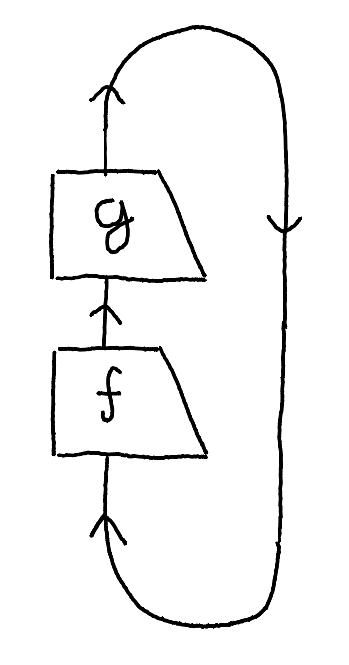
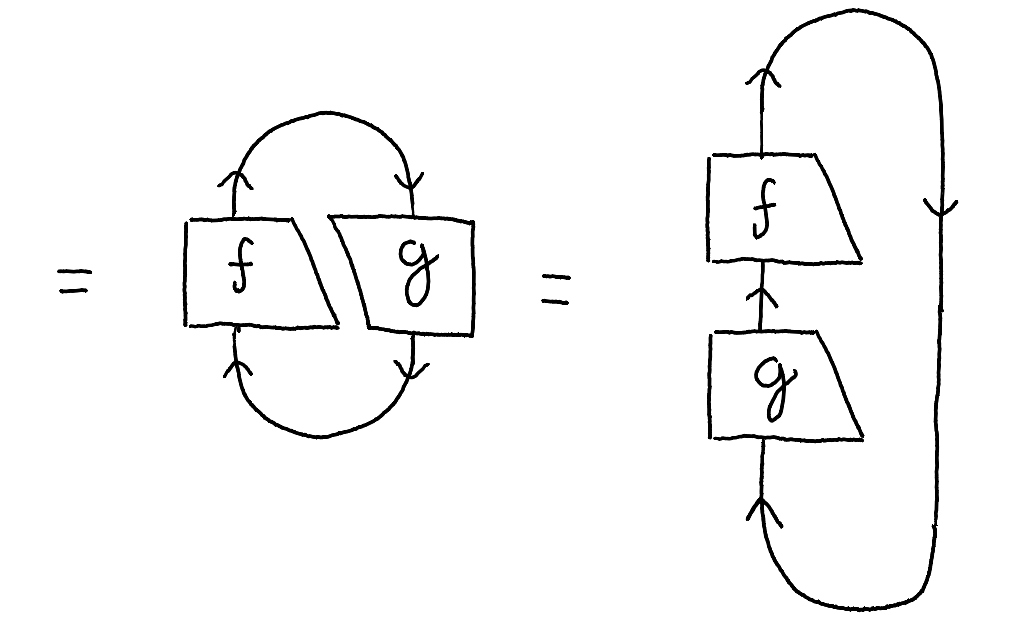
In a pivotal category, \(\text{tr}_{A}\left(g\circ f\right)=\text{tr}_{B}\left(f\circ g\right)\) for \(f:A\to B\) and \(g:B\to A\).
Proof
Graphically
Lemma (Properties of the trace)
In a pivotal monoidal category, the trace has the following properties
- \(\text{tr}_{A}\left(f+g\right)=\text{tr}_{A}\left(f\right)+\text{tr}_{A}\left(g\right)\) for any superposition rule \(+\)
- \($\text{tr}_{A\oplus B}\begin{pmatrix}f & g\\\) if there are biproducts
- \(\text{tr}_{I}\left(s\right)=s\) for any scalar \(s:I\to I\)
- \(\text{tr}_{A}\left(0_{A,A}\right)=0_{I,I}\) if there is a zero object
- \(\text{tr}_{A\otimes B}\left(f\otimes g\right)=\text{tr}_{A}\left(f\right)\circ\text{tr}_{B}\left(g\right)\) in a braided pivotal category
- \(\left(\text{tr}_{A}\left(f\right)\right)^{\dagger}=\text{tr}_{A}\left(f^{\dagger}\right)\) in a dagger pivotal category
Lemma (Properties of dimensions)
In a braided pivotal category, the following properties hold
- \(\dim\left(A\oplus B\right)=\dim A+\dim B\) if there are biproducts
- \(\dim\left(I\right)=\text{id}_{I}\)
- \(\dim\left(0\right)=0_{I,I}\) if there is a zero object
- \(A\simeq B\Rightarrow\dim A=\dim B\)
- \(\dim\left(A\otimes B\right)=\dim A\circ\dim B\)
More to come
In the next post I will move on to introducing notions necessary for reading the paper “An invitation to topological orders and category theory ” by Kong and Zhang. In particular, I will focus on \(\mathbb{C}-\)linear categories, simple and semisimple \(\mathbb{C}-\)linear categories and their interaction with all other types of structures we have introduced so far. This will lead naturally into the definition of (unitary) fusion categories, and modular tensor categories right after, which set the stage for building up the physical picture of topological order, coming up in the post after the next.